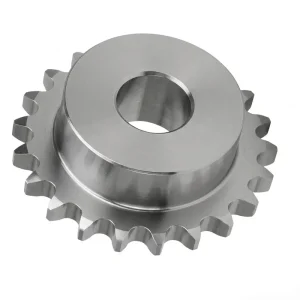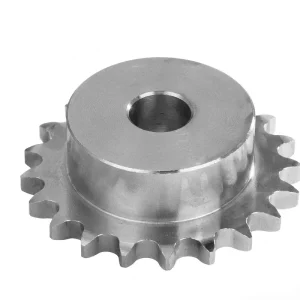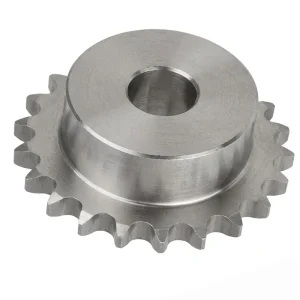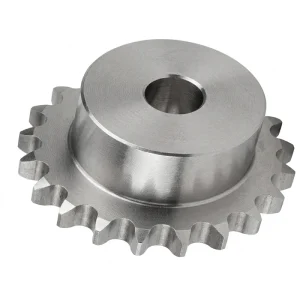
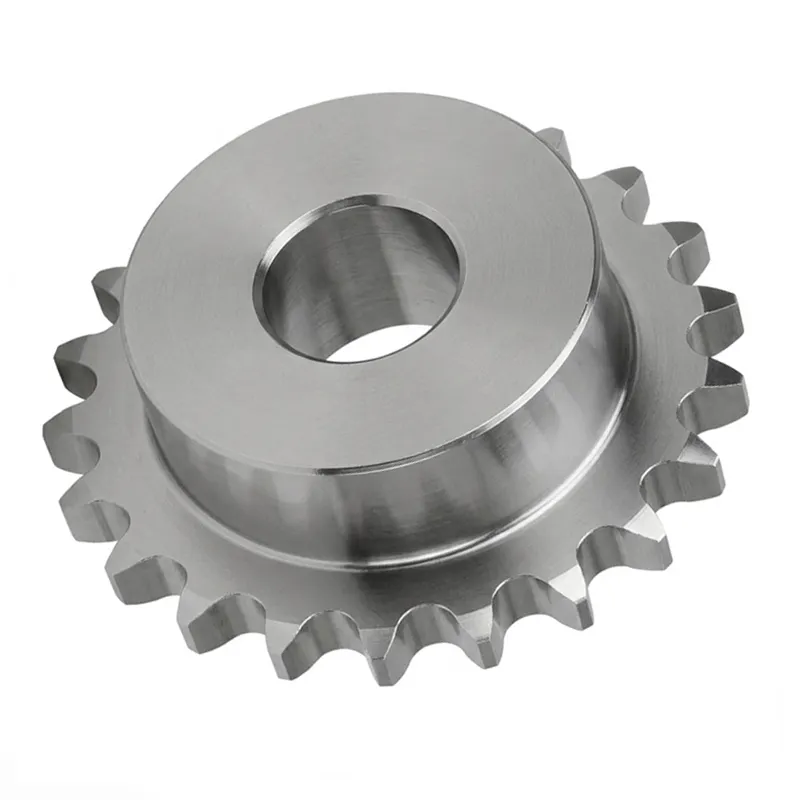
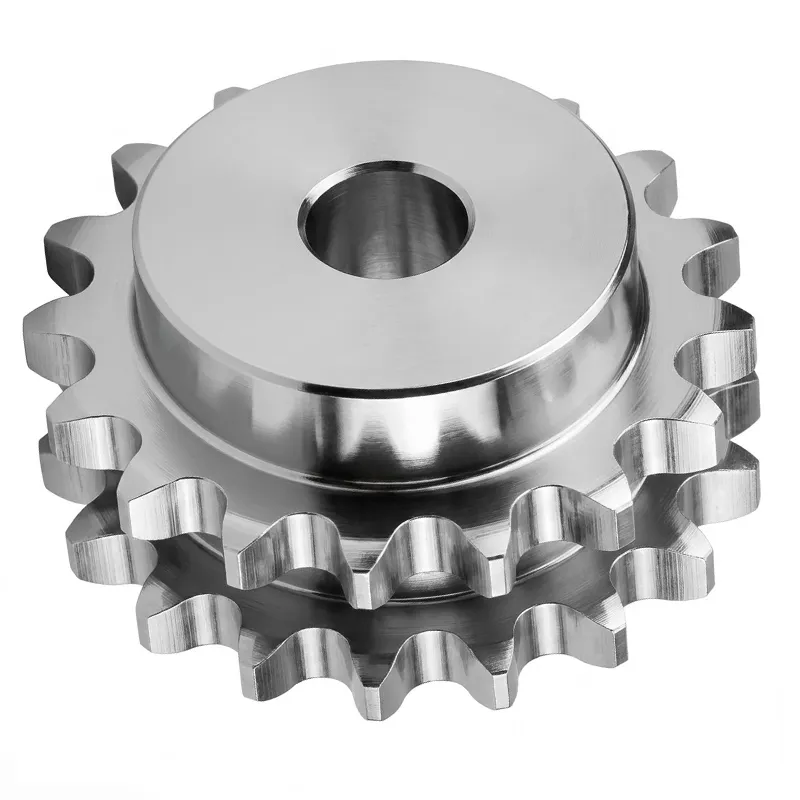
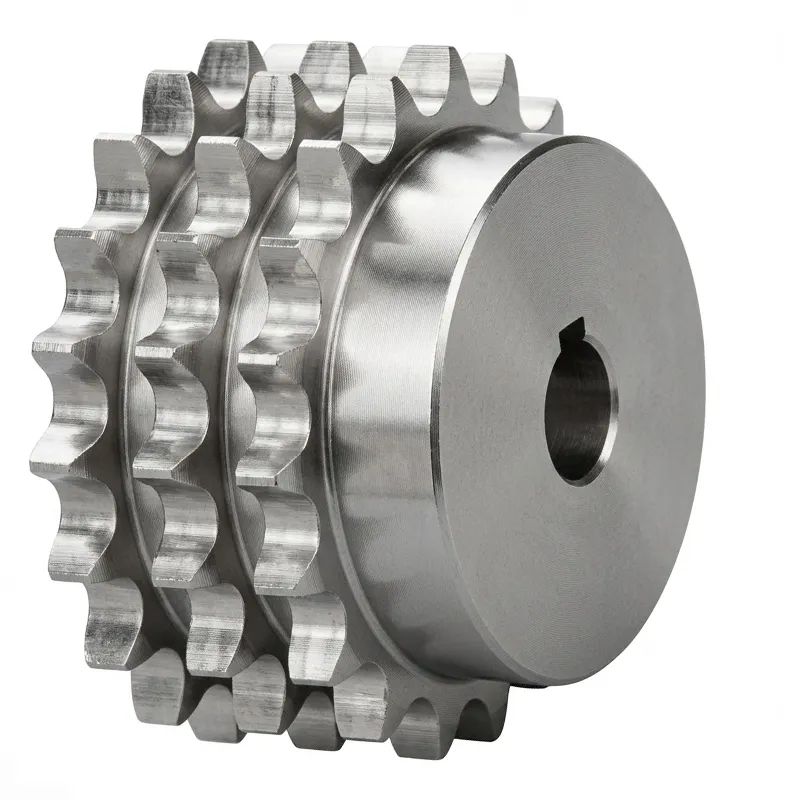
Zębatka europejska EP 1/2″×5/16″ — seria 08B-1-2-3
The 08B-1-2-3 designation signals three distinct strand configurations in a single product family. The “1” denotes simplex (single-strand), “2” duplex (two strands), and “3” triplex (three strands) — all sharing the same 12.7 mm pitch, 8.51 mm roller, and DIN 8187-specified tooth geometry.
The 5/16″ inner width (7.75 mm) that distinguishes this European Sprocket from the 1/8″ and 1/4″ variants in the same pitch class is not merely a dimensional difference — it implies a meaningfully heavier chain side plate. Wider side plates on the matched chain resist lateral bending and whip, which matters in drives with long unsupported chain spans, variable load, or shaft misalignment.
The Z=8 to Z=125 tooth count range gives this European Sprocket family a ratio span from near 1:1 to over 15:1 within one chain standard. Weld-on hub construction begins at Z=41 for simplex (marked *90) and Z=43 for both duplex (marked *108) and triplex (marked *120), reflecting the structural reality that hub wall thickness requirements at large diameters exceed what a through-bored blank can sustain.
EP 1/2"×5/16" European Sprocket — 08B-1-2-3 Series
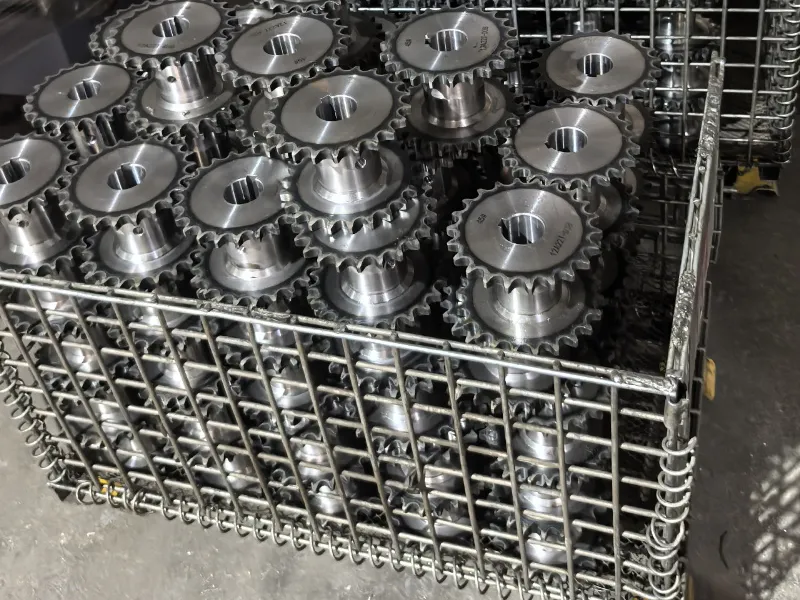
The EP 08B-1-2-3 series is one of the most versatile entries in the European Standard Sprockets Series: a single 1/2"×5/16" European Sprocket family that covers simplex, duplex, and triplex chain configurations within one documented product range. With a 12.7 mm chain pitch, 7.75 mm internal width, and 8.51 mm roller diameter, each unit in this series is manufactured in full compliance with DIN 8187 and ISO/R 606 — the foundational standards for European roller chain drives. The triplex capability sets the 08B-1-2-3 apart from most other families in the 1/2" pitch class: three parallel chain strands on a single sprocket hub triple the torque capacity of the drive without requiring a larger chain pitch or a complete drive system redesign.
Tooth counts run from Z=8 through Z=125, giving transmission engineers access to ratio spans from near 1:1 to greater than 15:1. The 5/16" inner width (7.75 mm) — wider than both the 1/8" and 1/4" variants in the 1/2" pitch family — accommodates heavier chain side plates that resist lateral deflection under dynamic loads. For engineering teams in Germany, Spain, Colombia, and other markets where DIN 8187 documentation is the procurement baseline, this product range delivers dimensional traceability, structural flexibility, and stock availability from a single qualified European Sprocket Manufacturer.
1. Technical Specification Parameters
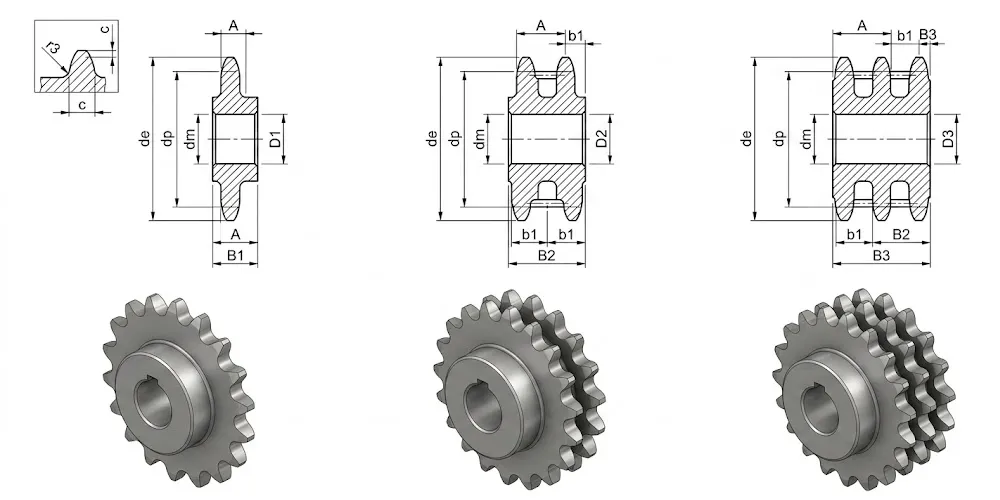
Full dimensional table for EP 08B-1-2-3 European Sprocket (simplex / duplex / triplex). d₃ = tip circle; dₚ = pitch circle; dₕ = hub bore; D₁/D₂/D₃ = bore by strand; A = hub width. All dimensions in mm.
| Z | d₃ | dₚ | S dₕ | S D₁ | S A | Du dₕ | Du D₂ | Du A | Tr dₕ | Tr D₃ | Tr A |
|---|---|---|---|---|---|---|---|---|---|---|---|
| 8 | 37.2 | 33.18 | 20 | 10 | 25 | 20 | 10 | 32 | 20 | 10 | 46 |
| 9 | 41.0 | 37.13 | 24 | 10 | 25 | 24 | 10 | 32 | 24 | 12 | 46 |
| 10 | 45.2 | 41.10 | 26 | 10 | 25 | 28 | 10 | 32 | 28 | 12 | 46 |
| 11 | 48.7 | 45.07 | 29 | 10 | 25 | 32 | 12 | 35 | 32 | 14 | 50 |
| 12 | 53.0 | 49.07 | 33 | 10 | 28 | 35 | 12 | 35 | 35 | 14 | 50 |
| 15 | 65.5 | 61.09 | 45 | 10 | 28 | 46 | 12 | 35 | 46 | 14 | 50 |
| 16 | 69.5 | 65.10 | 50 | 12 | 28 | 50 | 14 | 35 | 50 | 16 | 50 |
| 17 | 73.6 | 69.11 | 52 | 12 | 28 | 54 | 14 | 35 | 54 | 16 | 50 |
| 19 | 81.7 | 77.16 | 60 | 12 | 28 | 62 | 14 | 35 | 62 | 16 | 50 |
| 20 | 85.8 | 81.19 | 64 | 12 | 28 | 66 | 14 | 35 | 66 | 16 | 50 |
| 21 | 89.7 | 85.22 | 68 | 12 | 28 | 70 | 16 | 40 | 70 | 16 | 50 |
| 22 | 93.8 | 89.24 | 70 | 12 | 28 | 70 | 16 | 40 | 70 | 16 | 55 |
| 25 | 105.8 | 101.33 | 70 | 14 | 28 | 80 | 16 | 40 | 80 | 16 | 55 |
| 30 | 126.1 | 121.50 | 80 | 16 | 30 | 100 | 16 | 40 | 100 | 20 | 55 |
| 35 | 146.7 | 141.68 | 90 | 16 | 30 | 100 | 20 | 40 | 110 | 20 | 55 |
| 38 | 158.6 | 153.80 | 90 | 16 | 35 | 100 | 20 | 40 | 120 | 25 | 55 |
| 40 | 166.8 | 161.87 | 90 | 16 | 35 | 100 | 20 | 40 | 120 | 25 | 55 |
| 41 | 171.4 | 165.91 | *90 | 16 | 40 | *108 | 20 | 50 | *120 | 25 | 60 |
| 45 | 188.0 | 182.07 | *90 | 16 | 40 | *108 | 20 | 50 | *120 | 25 | 60 |
| 50 | 208.3 | 202.26 | *90 | 16 | 40 | *108 | 20 | 50 | *120 | 25 | 60 |
| 57 | 236.4 | 230.54 | *90 | 16 | 40 | *108 | 20 | 50 | *120 | 25 | 60 |
| 65 | 269.0 | 262.86 | *90 | 16 | 40 | *108 | 20 | 50 | *120 | 25 | 60 |
| 76 | 313.3 | 307.33 | *90 | 16 | 40 | *108 | 20 | 55 | *120 | 25 | 60 |
| 85 | 349.0 | 343.69 | *90 | 16 | 40 | *108 | 20 | 55 | *120 | 25 | 60 |
| 100 | 410.3 | 404.32 | *90 | 16 | 40 | *110 | 20 | 55 | *120 | 25 | 60 |
| 114 | 466.9 | 460.91 | *90 | 16 | 40 | *110 | 20 | 55 | *120 | 25 | 60 |
| 125 | 511.3 | 505.37 | *90 | 16 | 40 | *110 | 20 | 55 | *120 | 25 | 60 |
S = Simplex; Du = Duplex; Tr = Triplex. * = Weld-on hub. Contact us for all intermediate Z values and the complete dimensional datasheet.
3. Five Key Advantages of 08B-1-2-3 European Sprocket
The defining characteristic of the 08B-1-2-3 European Sprocket range is its three-strand scope. A machine designer starting with a simplex European Sprocket at Z=20 can escalate to a duplex or triplex configuration on the same shaft — same tooth count, same pitch circle, same shaft centres — by adding chain strands and fitting the wider hub variant. This scalability means that as load requirements grow over a machine's commercial life, the drive architecture remains unchanged: no new gearbox sizing, no shaft centre recalculation, no housing modification. For industrial machinery built on tight cost budgets in Colombia or Germany, that forward-compatibility has real commercial value.
Every European Sprocket in the 08B-1-2-3 series is produced and verified against DIN 8187 and ISO/R 606. These are not self-certified claims: tooth radius r₃ = 13 mm, radius width C = 1.3 mm, and strand widths B₁ = 7.2 mm, B₂ = 21 mm, and B₃ = 34.9 mm are all values specified in the normative documents, measurable with calibrated instruments, and reportable in dimensional inspection certificates. For procurement teams in Germany sourcing a replacement kettenrad zahnrader or specifying new industrial drives, and for Colombian buyers needing standards-referenced documentation for DIAN import clearance, this DIN/ISO traceability simplifies both incoming inspection and cross-border documentation.
The 7.75 mm inner width of the 08B-1-2-3 European Sprocket is the widest inner-width specification in the 1/2" pitch family documented here. Wider inner width means wider, heavier chain side plates, which in turn provide greater lateral bending stiffness. For a European Sprocket drive subject to variable load impulses — such as agricultural equipment traversing uneven terrain in Colombia's coffee and sugar-cane growing regions, or industrial conveyors in German facilities where product loading is irregular — the heavier side plate of the 5/16" chain reduces the risk of chain whip, lateral fatigue cracking, and premature chain elongation compared to the narrower 1/8" and 1/4" inner-width variants.
The dimensional table marks the transition from stock bore to weld-on hub construction: Z=41 for simplex (*90), Z=43 for duplex and triplex variants (*108 and *120). This documentation transparency prevents specification errors at the drawing stage. Engineers planning drive housings for large-diameter installations can account for the weld-on hub geometry — specifically the increased hub outer diameter that affects housing clearance — before tooling or fabrication begins, rather than discovering the constraint at assembly. This level of structural disclosure is consistent with the documentation standards expected from a qualified European Sprocket Manufacturer.
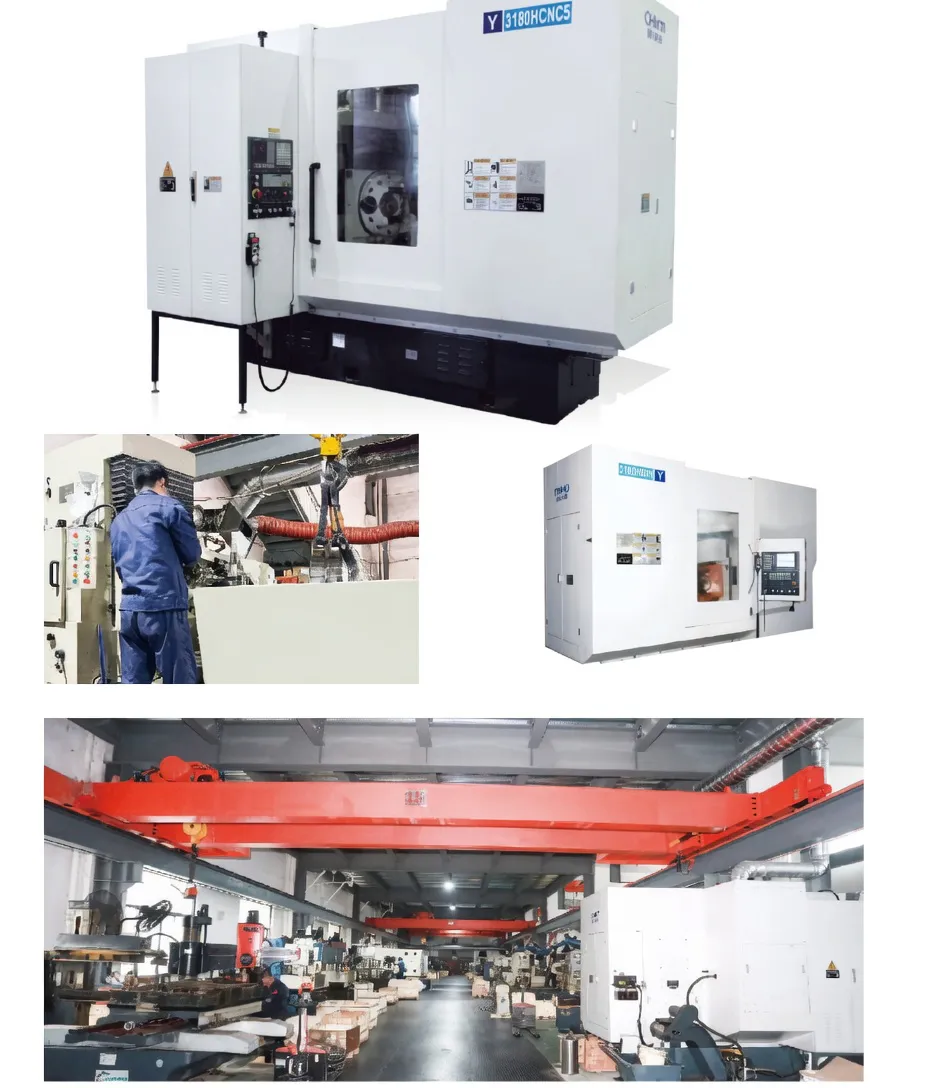
Producing a consistent r₃ = 13 mm tooth radius across tooth counts from Z=8 to Z=125 — and across three strand-width configurations — requires CNC machining rather than conventional hobbing alone. Our European Sprocket production uses CNC centres that hold tooth profile tolerances to DIN quality grade levels on every batch, not just on qualification runs. The result is predictable roller engagement noise, uniform tooth wear distribution, and a service life that matches the dimensional accuracy implied by the DIN 8187 specification. For industrial sprockets and gears operating in continuous-shift production environments in Colombia and Europe, this consistency reduces unplanned maintenance stoppages and extends the interval between European Sprocket replacement cycles.
4. How the 08B-1-2-3 European Sprocket Works
A European Sprocket is a positive-engagement power transmission element: unlike a friction pulley, it transfers torque through direct mechanical contact between each tooth and the corresponding chain roller. As the drive shaft rotates the input sprocket, teeth push the rollers forward sequentially, pulling the chain and driving the output shaft. Because engagement is positive, there is no slip, and the transmitted torque is governed only by the chain's rated tensile strength and tooth geometry — not by friction coefficient or surface condition. This is why sprockets and chains remain the preferred transmission choice in agricultural, conveyor, and industrial machinery where exact speed ratios must be maintained regardless of load variation.
In this series, tooth radius r₃ = 13 mm is the primary engagement geometry parameter. It is calculated to match the 8.51 mm roller diameter of the 08B chain: as the roller enters the tooth pocket from the approaching chain side, it rides along the tooth flank arc of 13 mm radius, seating at the pitch circle at the base of the tooth valley. Radius width C = 1.3 mm provides a flat relief at the tooth tip to prevent roller contact during chain articulation. The 1.3 mm C value in this European Sprocket is slightly wider than the 1.0 mm used in the 05B and 081B families — reflecting the larger roller diameter and the correspondingly greater geometric demands at the tooth tip.
The strand configurations — simplex (B₁ = 7.2 mm), duplex (B₂ = 21 mm), and triplex (B₃ = 34.9 mm) — represent increasing multiples of the single-strand width, with inter-strand gaps sized to the chain manufacturer's plate clearance specification. Each chain strand on a multi-strand European Sprocket carries an equal share of the total drive tension when the European Sprocket hub and shaft are correctly aligned, making load distribution inherently balanced in a well-installed triplex drive. The hub A dimension grows progressively from simplex through triplex for any given tooth count; weld-on hub construction begins at Z=41 (*90 simplex) and Z=43 (*108/*120 duplex/triplex), where through-bored blanks can no longer provide the hub wall thickness needed for multi-strand chain tension at large diameters.
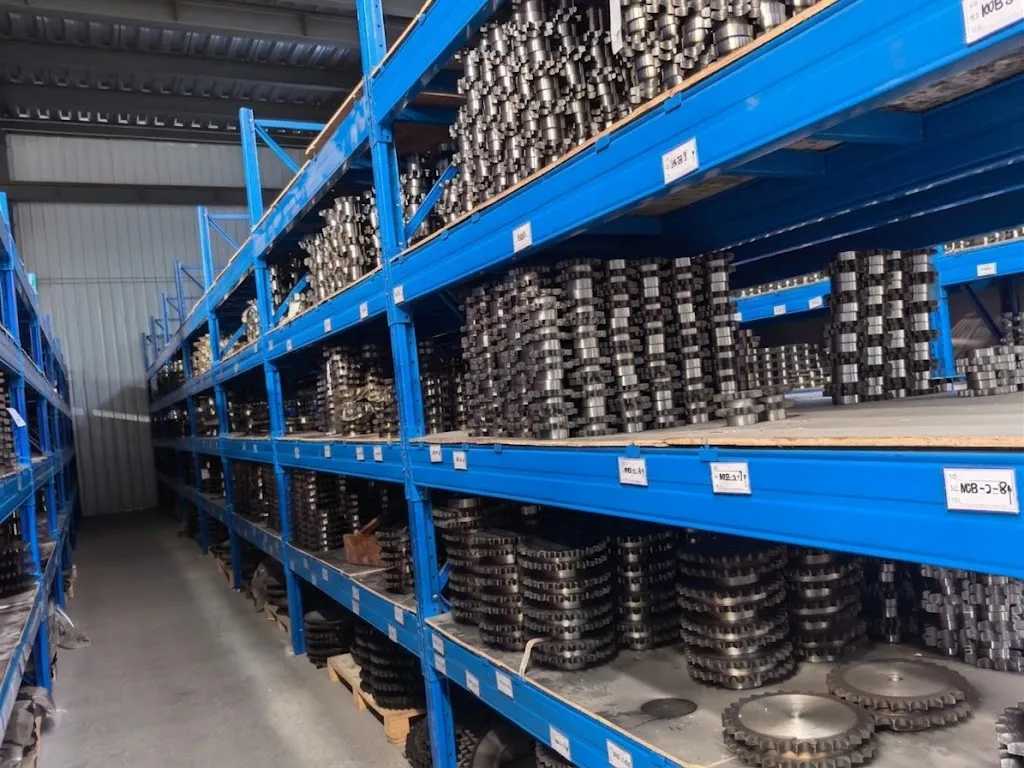
5. Material and Surface Treatment
C45 medium-carbon steel is the standard production material for the 08B-1-2-3 European Sprocket series, as specified in the product documentation. C45 is selected for its machinability and heat-treatability: induction hardening elevates tooth flank surface hardness to 50–58 HRC while leaving the hub core in tougher normalised condition. This hardness gradient is the correct approach for any roller chain sprocket that must resist both surface abrasive wear at the tooth flanks and impact shock loading (from sudden load application or start-stop cycling in agricultural and conveyor machinery). A fully hardened European Sprocket hub would be brittle under shock; a fully soft one would wear prematurely at the tooth contact surfaces.
For European Sprocket installations in environments where corrosion is a design concern — food and beverage production lines in Colombia subject to wash-down, outdoor agricultural drives in humid tropical climates, or chemical handling conveyors — stainless steel sprockets & gears in AISI 304 or AISI 316L are available as alternative material specifications. AISI 316L provides superior chloride resistance over 304, making it the preferred material for wash-down zones using hypochlorite or peracetic acid cleaning agents. Material test certificates for stainless variants include chemical composition and mechanical properties of the production heat, supporting material traceability requirements under hygiene compliance audits in Colombia and EU food production regulations.
Black oxide treatment on standard C45 European Sprocket blanks produces a black kettenrad zahnrader finish — visually distinctive and carrying a mild corrosion deterrent for low-humidity indoor storage and operation. Zinc phosphate and electroless nickel plating are available as further options, each with different performance characteristics in corrosion resistance and dimensional effect. Plastic sprockets and gears in POM or PA66 are produced for specific light-duty European Sprocket applications where noise reduction, weight minimisation, or metal-free operation in the drive zone are design requirements, though load and temperature ratings for polymer variants are significantly lower than for steel. All surface treatment options for this series are RoHS-compliant and SVHC-declarable on request.
C45 Steel
Standard for this European Sprocket; induction-hardenable tooth flanks
AISI 316L
Best chloride resistance among stainless steel sprockets & gears options
AISI 304
General-purpose stainless for this European Sprocket in moist environments
Black Oxide
Black kettenrad zahnrader finish; mild protection for dry-indoor drives
POM / PA66
Plastic sprockets and gears for light-duty, non-metallic European Sprocket applications
6. Application Scenarios
The 08B-1-2-3 is specified wherever the drive requires more torque capacity than a narrow 1/2" chain can provide, but a change to a larger chain pitch would be mechanically disproportionate or commercially inconvenient. The triplex European Sprocket option in particular opens application territory that most 1/2" pitch sprocket families cannot reach without moving to a completely different chain standard.
Combine harvester grain elevators, forage harvester chopping heads, sugar cane cutting machinery, and PTO-driven field implements across Colombian and European agricultural operations frequently use 1/2"×5/16" chain drives for main power transmission stages. The range covers both simplex drives on lighter implements and duplex drives on heavier multi-section harvesters, while the triplex European Sprocket variant handles the highest-torque agricultural applications — such as the main chain stage of a large-capacity forage wagon — without switching to the 16A or 20A heavy pitch families. This pitch versatility reduces the number of distinct chain standards a service workshop needs to carry for agricultural replacement kettenrad zahnrader stock.
Overhead power-and-free conveyors, pallet accumulation systems, and heavy roller conveyors in automotive and general manufacturing plants specify industrial sprockets and gears in the 5/16" inner width class where the chain strand must carry both axial tension and the lateral loading of off-centre products or directional changes. Duplex and triplex configurations are common specifications for head-drive drums and return stations, where doubling or tripling the strand count reduces the load per link — extending both chain and European Sprocket service life without a drive redesign. German automotive facility conveyor specifications frequently reference this European Sprocket format.
Bottling line conveyors, can-handling systems, tray sealers, and pasteurisation line transport drives in food and beverage facilities use 08B chain drives with stainless steel European Sprocket components in wash-down zones where regular chemical cleaning is routine. In Colombian food manufacturing — particularly in the processing of fresh flowers, coffee, and tropical fruit for export markets — stainless steel sprockets & gears conforming to DIN 8187 are increasingly specified to satisfy the European import partner's machinery documentation expectations. A duplex unit at mid-tooth counts provides the torque headroom for heavily loaded bottle conveyors without requiring a larger pitch chain that would not fit in existing machine housings.
Aggregate sorting screens, stone crusher feed conveyors, and underground material haulage auxiliary drives encounter sustained high-torque loads that push single-strand chain drives to their limits. The triplex European Sprocket — with weld-on hub construction from Z=43 upward — is a practical specification for these applications: three parallel chain strands on a single European Sprocket hub provide the combined tensile capacity needed without stepping to the heavier 16A or 20A pitch chains. For mining operators in Colombia's coal and mineral extraction regions, where spare parts logistics favour common component standards, the DIN 8187 traceability of this European Sprocket simplifies cross-border procurement from European suppliers.
High-speed cartoning, shrink-wrapping, and letterpress printing machinery use chain drives with chain gears and sprockets in the 1/2" pitch range for synchronisation of multi-station production lines. The 08B-1-2-3 European Sprocket in simplex configuration covers the lighter drive stages where B₁ = 7.2 mm tooth width is appropriate; duplex European Sprocket variants handle the main drive stages on large-format packaging lines where torque from multiple section drives accumulates. Print registration drives in commercial printing plants across Colombia and Spain specify best european sprockets in this pitch class where consistent tooth pitch geometry governs print-to-print accuracy across long production runs.
Weaving looms, knitting machines, and garment production conveyors in Colombia's significant textile manufacturing sector use European Sprocket drives in the 1/2" pitch class for pattern indexing, fabric advance mechanisms, and overhead transport. The controlled tooth geometry and 7.75 mm inner width of the 08B-1-2-3 European Sprocket ensures consistent chain speed at the moderate drive speeds typical of textile machinery — avoiding the chordal speed variation that causes fabric pickup irregularities on looms. The compact tip circle diameter at low tooth counts (Z=8, d₃ = 37.2 mm) allows the European Sprocket to fit within the tight space constraints common in textile machine frames.
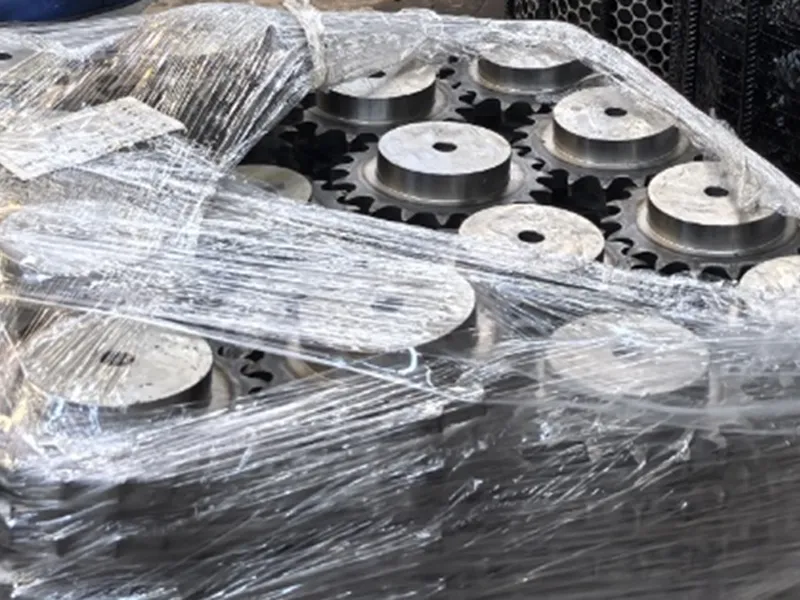
7. Regional Standards and Regulatory Context
Specifying a European Sprocket for cross-border machinery projects requires understanding how DIN 8187 and ISO/R 606 standards connect with each target market's regulatory and documentation framework.
EU — Machinery Regulation (EU) 2023/1230
The CE Technical File for machinery incorporating an 08B European Sprocket should reference DIN 8187 / ISO/R 606 as the harmonised component standard. Machinery Regulation (EU) 2023/1230 — entering full application in 2027 — maintains this approach. A European Sprocket does not individually require CE marking; it is covered by the machine-level declaration. Dimensional conformity documentation for the European Sprocket supports the Technical File risk assessment without additional certification burden.
Germany — DIN 8187 and DIN 8181
Sprockets germany procurement defaults to DIN 8187 for roller chain sprockets and DIN 8181 for precision short-pitch chains. A new kettenrad zahnrader or replacement kettenrad zahnrader in German machinery must conform to these norms. Our 08B-1-2-3 European Sprocket is fully documented to DIN 8187, with inspection records available at order placement for supplier qualification audits. The size kettenrad zahnrader enquiry process for this European Sprocket family is straightforward — provide tooth count, strand count, and bore requirement.
Colombia — ICONTEC, DIAN, INVIMA and RETIE
Colombian import of this European Sprocket falls under DIAN HS code 8483.40.90. Food-contact applications in Colombia require INVIMA-compatible material documentation — available for stainless steel European Sprocket variants. Electrically actuated drives incorporating the European Sprocket must comply with RETIE electrical safety regulations. ICA phytosanitary records apply for agricultural machinery imports. ICONTEC's adoption of ISO 606 as the Colombian chain component standard aligns directly with the ISO/R 606 basis of this European Sprocket series.
UK — UKCA and BS EN ISO 606
Post-Brexit UK machinery requires UKCA marking based on BS EN ISO 606, the British transposition of ISO 606 — which is dimensionally harmonised with DIN 8187. The 08B-1-2-3 European Sprocket conformity documentation is compatible with UKCA Technical File requirements. UK machinery OEMs sourcing this European Sprocket for dual EU/UK machines can use the same conformity records for both CE and UKCA audit purposes.
USA — ANSI #40 / #41 Distinction
The 08B European Sprocket at 12.7 mm pitch has the same pitch number as ANSI #40 / #41 chain, but both inner widths and roller diameters differ: 08B uses 7.75 mm inner width and 8.51 mm roller; ANSI #40 uses 7.94 mm inner width and 7.92 mm roller. These are not interchangeable. US buyers should verify DIN 8187 compliance explicitly when importing this European Sprocket for machinery exported to European or Latin American markets.
EU Environmental — RoHS and REACH
Surface treatments on steel sprockets and gears — including zinc phosphate and black oxide applied to this European Sprocket — must comply with EU RoHS Directive 2011/65/EU and REACH Regulation EC 1907/2006 for EU-market machinery. Our European Sprocket surface treatment processes are fully RoHS-compliant, with SVHC substance declarations available in the compliance documentation upon request.
8. Compatible Products — System Supply
Each 08B-1-2-3 European Sprocket operates as part of a chain drive assembly. We supply the matched chain and speed-control components that connect to this European Sprocket, providing a single verified source for the complete drive system.
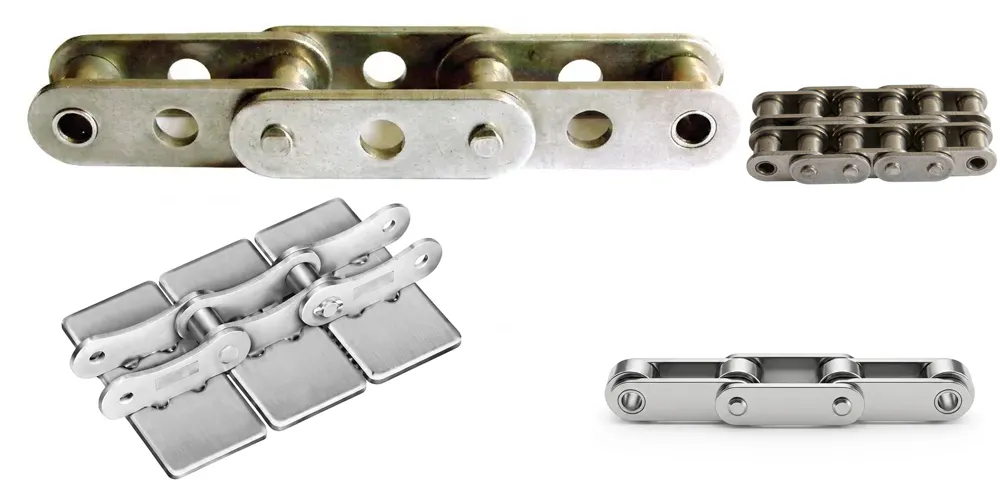
Roller Chain — Matched to 08B European Sprocket
Each configuration of the 08B-1-2-3 European Sprocket requires a specifically dimensioned chain: 12.7 mm pitch, 7.75 mm inner width, 8.51 mm roller diameter, conforming to DIN 8187. The simplex configuration runs one strand; duplex and triplex run two and three parallel strands of the same chain respectively. Purchasing sprockets and chains from a single verified supply source eliminates the specification inconsistencies that arise when components come from manufacturers who interpret the same ISO standard slightly differently.
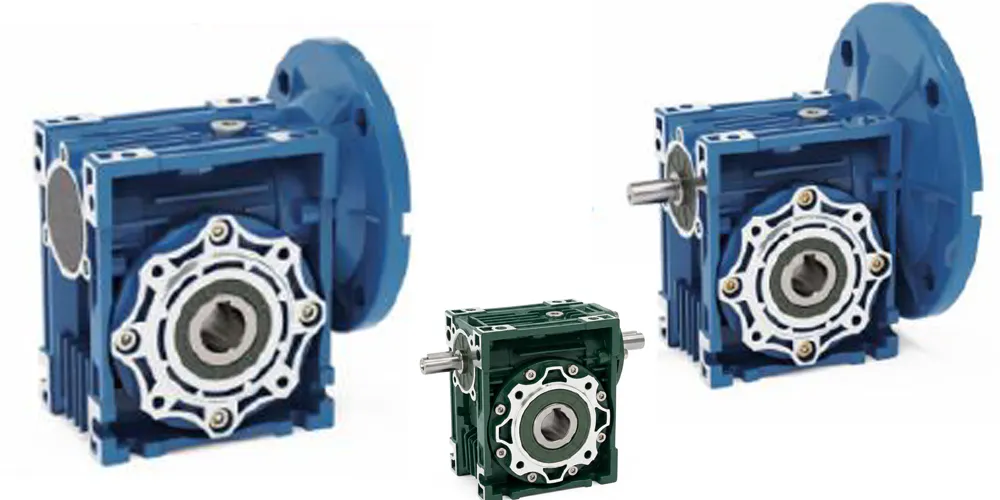
NMRV Worm Reducers — Speed Matching Input Stage
Where a motor must be speed-reduced before driving the 08B-1-2-3 European Sprocket chain stage, NMRV worm gear reducers provide compact right-angle reduction at ratios from 5:1 to 100:1. The output shaft bore range of standard NMRV reducers aligns with the stock-bore range of the 08B-1-2-3 European Sprocket at typical low-to-mid tooth counts, making shaft-to-sprocket installation straightforward without custom adapters in most standard configurations. This integrated supply — NMRV reducer coupled directly to the sprocket drive stage — is a practical one-stop solution for conveyor heads, agitator drives, and main drive stages on packaging machines across European and Colombian industrial facilities.
9. About Us
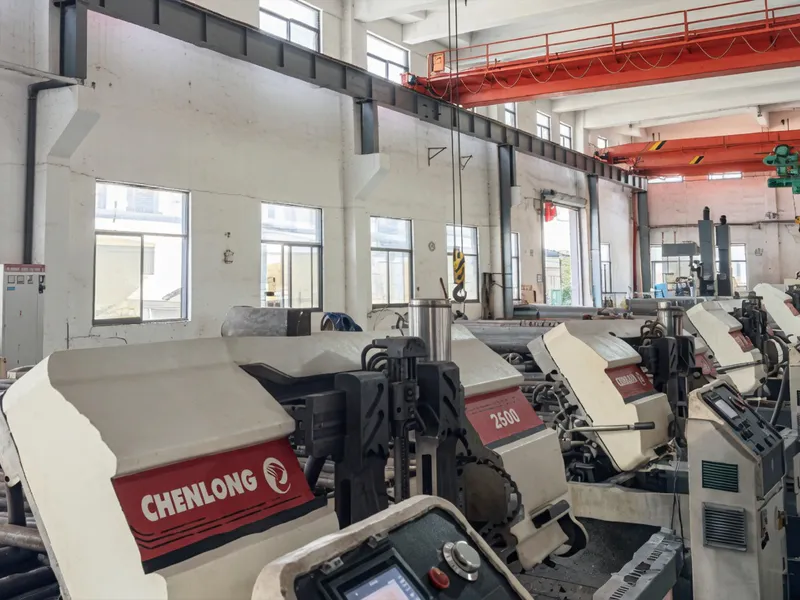
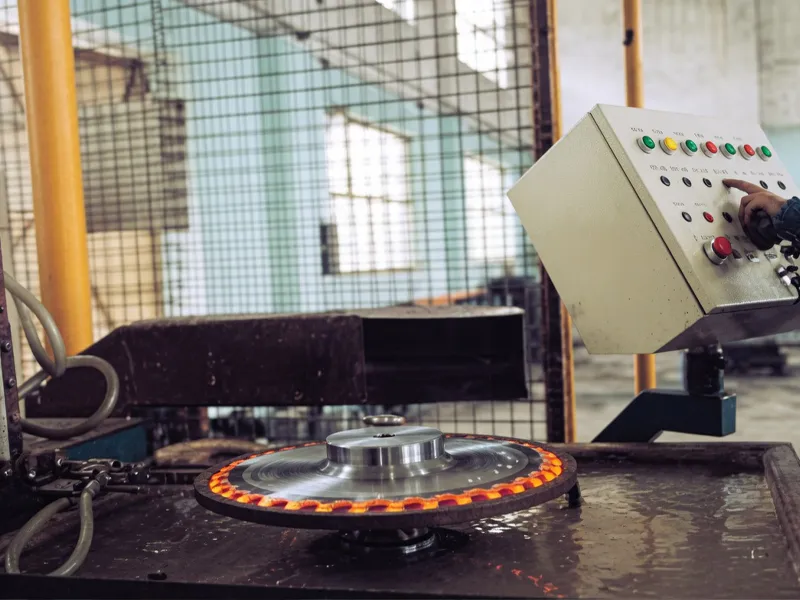
We have been manufacturing precision power transmission components since 2010 — over fifteen years of focused experience in roller chain European Sprocket and gear production. Our facility runs dedicated CNC hobbing and machining centres capable of holding tooth profile tolerances to DIN quality grade levels across every European Sprocket configuration in this range, from compact Z=8 simplex units to large-diameter Z=125 triplex weld-on hub assemblies. Every tooth is cut, measured, and documented within our own controlled manufacturing environment — we do not subcontract primary machining — which gives our customers traceable accountability from material certification through to dimensional inspection records on every shipment.
Our product catalogue spans the three principal international roller chain standards — European DIN/ISO, American ANSI/ASME, and Asian JIS — together with a comprehensive gear range including spur gears, bevel gears, and racks conforming to DIN 782. Buyers sourcing gears and sprockets across global machinery standards can deal with one European Sprocket Manufacturer rather than managing separate suppliers for each standard. Each European Sprocket tooth profile is verified against DIN 8187, ANSI B29.1, or JIS B 1801 as applicable; gear tooth accuracy is documented to DIN 3961 / ISO 1328 levels. Stock items are available for same-week dispatch; OEM custom variants with non-standard bores, keyways, and surface treatments are supported by our engineering team with full dimensional documentation packages.
We serve customers directly in Germany, Spain, Italy, the Netherlands, and Poland, alongside growing export business in Colombia, Mexico, Peru, and Southeast Asia. Whether you are searching for best european sprockets from a qualified industrial chains and sprockets europe factory, requesting a size kettenrad zahnrader quote for a specific Z count and bore, or evaluating european sprockets for sale in simplex, duplex, or triplex configuration — our technical and commercial teams can provide accurate specifications, lead times, and documentation without delay.
Warsztat
Często zadawane pytania
Redaktor: PXY