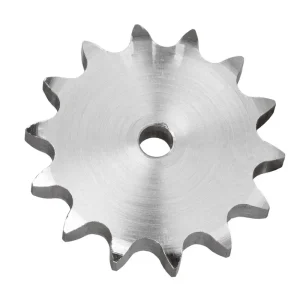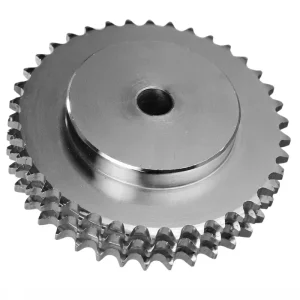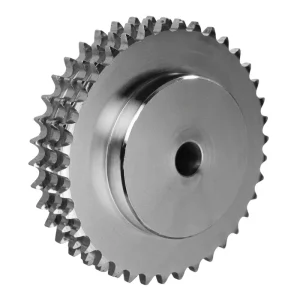
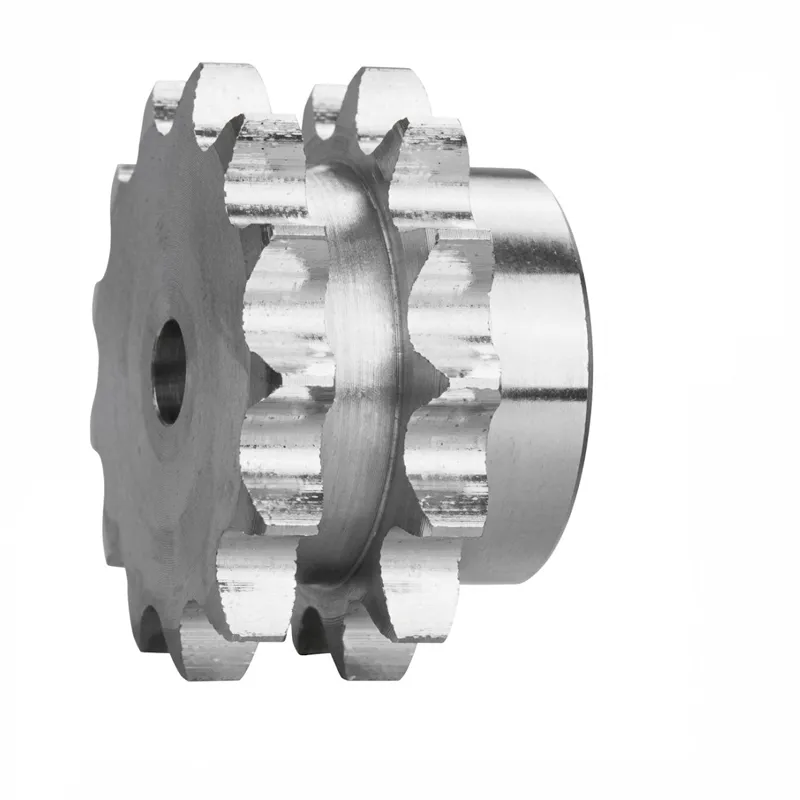
EP-⌀0.75″ American Sprockets — Pignoni in acciaio per stock
The EP-⌀0.75″ carries the ANSI designation No.100-2, identifying it as a double-strand (duplex) steel stock sprocket within the No.100 chain family. The No.100 designation specifies a 1¼-inch pitch — one of the most widely used pitch sizes in North American heavy industrial chain drives — with a 0.750-inch (3/4″) roller diameter. The duplex “-2” suffix means the sprocket features two parallel sets of tooth rows that engage two side-by-side chain strands simultaneously, doubling the torque capacity relative to a simplex No.100-1 drive without requiring a larger pitch or a wider shaft-centre layout.
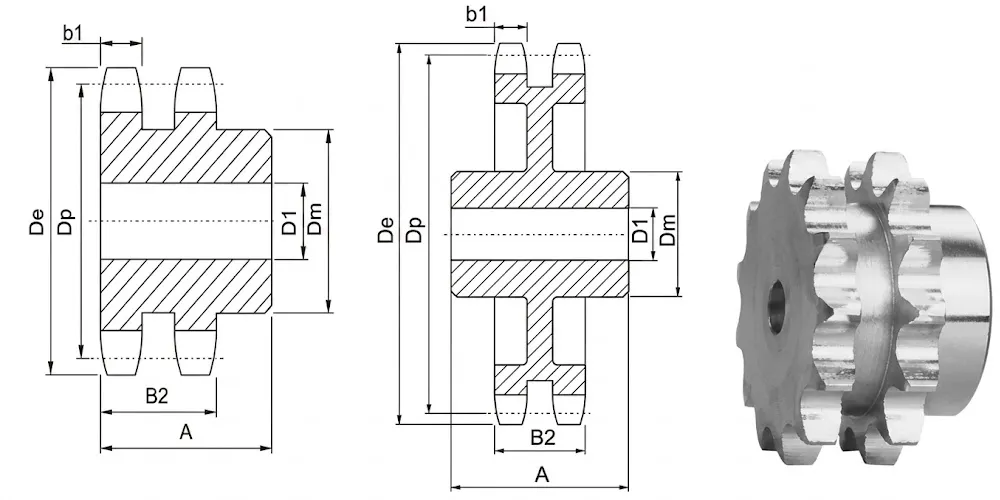
The defining dimensional parameters for this series are the simplex tooth width b1 of 0.669 inches and the duplex tooth width B2 of 2.077 inches. These two values reflect the geometry of the dual-strand chain: each strand requires a tooth width sized to the 0.669-inch inner link clearance, and the combined two-strand width, including the inter-strand spacing, produces the 2.077-inch total hub width B2. Maintaining both values within ANSI B29.1 tolerances is critical to correct roller engagement across both strands simultaneously — any deviation produces unequal load sharing between strands, which accelerates fatigue in the more heavily loaded chain.
The tooth count range spans from Z=9 through Z=80, with outer diameters from 4.180 inches at Z=9 up to 32.570 inches at Z=80. Hub configuration divides between Type B (offset extended hub, Z=9–Z=35) and Type C (centred hub, Z=45–Z=80), following the standard ANSI hub configuration logic for this pitch range.
Serie di pignoni American Standard
EP-⌀0.75" American Sprockets — No.100-2 Steel Stock Sprockets
The No.100-2 is a double-strand (duplex) American sprocket built to ANSI/ASME B29.1 specifications, designed for 1¼-inch pitch roller chain with a 0.750-inch (3/4") roller diameter. Available in Type B and Type C hub configurations from 9 to 80 teeth, with tooth widths of 0.669 inches (simplex b1) and 2.077 inches (duplex B2), this american standard chain sprocket series addresses the medium-heavy industrial drive market where the No.80 simplex range falls short of the required torque rating but the full triple-strand No.80-3 configuration is overspecified. From grain handling and oil field equipment in Colombia to heavy processing machinery across North America, the No.100-2 delivers reliable ANSI-standard power transmission in a proven double-strand format.
1. Technical Specifications — No.100-2 American Sprockets (⌀0.75" Roller, Double-Strand)
Full dimensional data for the No.100-2 double-strand American standard sprockets range. Outer diameter (De), bore range (D1 Min/Max), hub diameter (Dm), hub width (A), and approximate weight (lbs) are listed for each tooth count. Type B hub covers Z=9–Z=35; Type C covers Z=45–Z=80.
Pitch: 1¼"
Roller Φ: 0.750"
Norma: ANSI B29.1
b1 (simplex): 0.669"
B2 (duplex): 2.077"
Double-strand (No.100-2)
Type B: Z=9–35
Type C: Z=45–80
Materiale: acciaio al carbonio
| No. Denti | Numero | De (in) | Tipo | D1 Min (pollici) | D1 Max (pollici) | Dm (pollici) | A (in) | Peso in libbre (circa) |
|---|---|---|---|---|---|---|---|---|
| 9 | D100B09 | 4.180 | B | 1 | 1⅞ | 2⅞ | 2⅞ | 4.6 |
| 10 | D100B10 | 4.600 | B | 1 | 1⅞ | 2¾ | 2⅞ | 6.2 |
| 11 | D100B11 | 5.010 | B | 1 | 2⅞ | 3½ | 2⅞ | 7.9 |
| 12 | D100B12 | 5.420 | B | 1¼ | 2¼ | 3½ | 2⅞ | 9.3 |
| 13 | D100B13 | 5.820 | B | 1¼ | 2½ | 3⅞₃₆ | 2⅞ | 11.4 |
| 14 | D100B14 | 6.230 | B | 1¼ | 2¾ | 4⅞₆ | 2⅞ | 13.6 |
| 15 | D100B15 | 6.630 | B | 1¼ | 3½ | 4⅞ | 3⅞ | 17.1 |
| 16 | D100B16 | 7.030 | B | 1¼ | 3⅞₃₆ | 5 | 3⅞ | 20.1 |
| 17 | D100B17 | 7.440 | B | 1¼ | 3½ | 5¼ | 3⅞ | 23.1 |
| 18 | D100B18 | 7.840 | B | 1¼ | 3½ | 5¼ | 3⅞ | 25.4 |
| 19 | D100B19 | 8.240 | B | 1¼ | 3¾ | 5½ | 3⅞ | 29.6 |
| 20 | D100B20 | 8.640 | B | 1¼ | 3¾ | 5½ | 3⅞ | 32.4 |
| 21 | D100B21 | 9.040 | B | 1¼ | 3¾ | 5½ | 3⅞ | 35.3 |
| 22 | D100B22 | 9.440 | B | 1¼ | 3¾ | 5½ | 3⅞ | 38.4 |
| 23 | D100B23 | 9.840 | B | 1¼ | 3¾ | 5½ | 3⅞ | 41.3 |
| 24 | D100B24 | 10.250 | B | 1¼ | 3¾ | 5¾ | 3⅞ | 45.1 |
| 25 | D100B25 | 10.650 | B | 1¼ | 3¾ | 5¾ | 3⅞ | 48.5 |
| 26 | D100B26 | 11.050 | B | 1½ | 3¾ | 5¾ | 3⅞ | 51.5 |
| 30 | D100B30 | 12.640 | B | 1½ | 3¾ | 5¾ | 3⅞ | 65.0 |
| 35 | D100C35 | 14.640 | C | 1½ | 3⅞₃₆ | 6 | 4¼ | 75.0 |
| 45 | D100C45 | 18.630 | C | 1½ | 3⅞₃₆ | 6 | 4½ | 103 |
| 60 | D100C60 | 24.600 | C | 1½ | 5⅞ | 7½ | 5 | 175 |
| 70 | D100C70 | 28.580 | C | 1½ | 5⅞ | 7½ | 5 | 197 |
| 80 | D100C80 | 32.570 | C | 1½ | 5⅞ | 7½ | 5 | 231 |
All dimensions in inches. Type B=extended single-side hub; Type C=centred hub. Weights approximate. Tolerances per ANSI B29.1.
2. Five Key Advantages of the No.100-2 American Sprocket
① Double-Strand Capacity on 1¼" Pitch — Optimal Mid-Range Torque
The No.100-2 fills the torque gap between the No.80 simplex and the larger No.120 pitch systems. By running two parallel No.100 chain strands on a single sprocket shaft, the drive achieves twice the power transmission of a simplex No.100-1 without stepping up to a coarser pitch that would require heavier shaft bearings and a physically larger drive package. For industrial buyers evaluating american sprockets sizes in the medium-heavy duty range, the No.100-2 is consistently the preferred solution where the No.80 single-strand reaches its capacity limit.
② ANSI B29.1 Verified — 0.750" Roller, 1¼" Pitch Throughout
Every No.100-2 sprocket is CNC-machined and coordinate-measured against ANSI/ASME B29.1 before release. The 0.750-inch roller diameter, 1¼-inch pitch, and ANSI-specified tooth form are confirmed within tolerance across the complete Z=9–Z=80 range. For procurement teams sourcing american sprockets for sale as replacement components or OEM build parts, this verified conformance eliminates the dimensional uncertainty that would otherwise require dimensional checks at installation — reducing commissioning time and the risk of early-life sprocket wear from geometry mismatch between chain and sprocket.
③ Type B and Type C Hubs — Correct Configuration for Every Tooth Count
Type B (extended single-side hub) covers Z=9 through Z=35, where the boss diameter relative to the outer diameter requires maximum bore depth. Type C (centred hub) covers Z=45 through Z=80, where the large pitch circle allows symmetric hub placement that distributes shaft load evenly across both bearings. This configuration split is a defining characteristic of well-engineered american standard chain sprockets — it is not simply a stock item classification but an engineering decision that affects drive shaft bending loads and bearing life in the installed machine.
④ Induction-Hardened Carbon Steel — Rated for Industrial Duty
Standard material is carbon steel with induction-hardened tooth flanks (HRC 45–55). This combination delivers the surface hardness needed to resist roller contact wear over extended service cycles while keeping the hub core ductile enough to absorb shock loading without cracking. What is the best steel for sprockets in heavy industrial applications? Induction-hardened medium-carbon steel consistently outperforms aluminium, untreated carbon steel, and cast iron for No.100 pitch chain drive applications operating under sustained or variable load — it is the material of choice for american made sprockets in this duty range.
⑤ Stock Bore Inventory Plus Full Custom OEM Manufacturing
Stock bore No.100-2 sprockets covering Z=9 through Z=80 are held in inventory for same-week dispatch, covering the MRO and emergency replacement market without machining lead times. For OEM programmes requiring specific bore diameters, keyways, split hub, or QD bushing adaptations, our engineering team machines to customer drawing. This dual-track model — immediate stock plus engineered custom — makes us a reliable single-source custom sprocket manufacturer for both production planning and unplanned maintenance events across North America and Colombia.
3. Working Principle — How the No.100-2 American Sprocket Drives Heavy Loads
The No.100-2 operates on the positive-engagement principle common to all roller chain sprockets: as the sprocket rotates, each tooth enters the chain from below, seats the chain roller in the tooth gullet, and pulls the chain forward through direct mechanical contact between the hardened tooth flank and the roller surface. There is no slip — the velocity ratio between drive and driven sprockets is fixed and exact, regardless of the load within the rated capacity. This is the fundamental reason industrial designers choose chain and sprocket drives over friction belt systems where positional accuracy, synchronisation, or high torque at low speed are required.
The double-strand "-2" configuration adds a critical load distribution mechanism to this basic engagement principle. Two separate No.100 chains run in parallel, each engaging its own set of tooth rows on the sprocket. The torque transmitted by the drive is shared across both chains, so each carries approximately half the tension of a single-strand No.100-1 at the same power level. This halving of individual chain tension is what moves the chain from a marginal fatigue loading condition — which would produce chain elongation and early link failure — into a comfortable operating band well within the ANSI B29.1 rated working load. For buyers selecting american standard sprockets for applications that are just above the simplex No.100-1 capacity, the No.100-2 double-strand format is the most cost-efficient capacity upgrade available.
The transition from Type B to Type C hub at the Z=35–Z=45 boundary reflects the geometry of the larger pitch sprocket. At small tooth counts, the boss diameter is a large fraction of the outer diameter, and an extended one-side hub (Type B) maximises bore depth for shaft engagement. As the outer diameter grows, the pitch circle becomes large enough that a centred, symmetrical hub (Type C) provides better bending load distribution without sacrificing bore depth. This hub geometry transition is standard practice in ANSI-compliant industrial sprockets and gears for the No.100 pitch family and is reflected in the ANSI B29.1 dimensional tables that define the series.
4. Material and Surface Treatment Options of American Sprocket
Carbon steel with induction-hardened tooth flanks is the standard material specification for the No.100-2 American sprocket series, satisfying the ANSI B29.1 material requirements for industrial chain drive sprockets in the medium-heavy duty category. The induction hardening process targets the tooth flanks specifically — raising surface hardness to HRC 45–55 at the roller contact zone without affecting the ductility of the hub and bore section, which must remain capable of absorbing keyway-transmitted shock loads during start-up and load reversal. What sprocket is better, aluminum or steel? For the 1¼-inch pitch No.100-2 load range, carbon steel with surface hardening is the definitive answer — aluminium cannot provide adequate hardness at the tooth contact surface under sustained industrial chain loads without rapid wear.
For corrosion-sensitive applications, stainless steel sprockets and gears in AISI 316 are available across the No.100-2 tooth count range. The tooth geometry and ANSI B29.1 dimensional conformance are identical to the carbon steel standard, allowing direct material substitution without re-engineering the drive. AISI 316 is the preferred stainless grade for chemical plant conveying, food processing wash-down positions, and humid tropical installations — including Colombian coastal industrial facilities and Andean region agriculture operations where seasonal moisture exposure affects component service life. Material certificates for AISI 316 components are provided with each order, supporting INVIMA and FDA 21 CFR compliance documentation for food and pharmaceutical buyers.
Surface treatment options for carbon steel stock sprockets include black oxide (the black kettenrad zahnrader finish), which provides a dimensionally negligible corrosion-inhibiting layer suited to precision bore sprockets where coating thickness cannot be tolerated. Zinc phosphate with oil offers stronger rust protection for components destined for tropical-climate storage or extended sea-freight transit to Colombian and Latin American ports. For replacement kettenrad zahnrader applications where the original sprocket carried a specific surface treatment, we can match the treatment specification on custom orders to maintain interchangeability with the existing shaft and keyway clearances.
5. Application Scenarios of American Sprocket
The No.100-2 double-strand American sprocket occupies the segment of the industrial chain drive market where high torque, sustained duty, and ANSI B29.1 chain compatibility are all required simultaneously. The applications below represent the primary sectors where this series delivers reliable long-service performance.
Heavy Industrial Conveyor and Material Handling
Steel service centre coil handling lines, automotive stamping press material feeds, and heavy warehouse floor conveyors handling loaded pallets at sustained throughput rates use No.100-2 sprockets in head-shaft and intermediate drive positions. The double chain sprocket gear configuration carries twice the chain tension rating of a simplex No.100-1 drive, which is typically the margin needed to handle full-capacity loads without exceeding the ANSI B29.1 service factor limits for continuous-duty industrial conveyors. Industrial sprockets and gears in this pitch and strand count are among the most widely stocked items in North American MRO supply chains.
Agricultural Machinery — Colombia and Latin America
American-built sugarcane harvesters, combine headers, and cotton gin equipment operating in Colombia, Brazil, and Argentina predominantly use ANSI B29.1 chain standards throughout their drive systems. Field maintenance teams sourcing replacement sprockets for No.100 chain drives must verify both the chain designation (No.100 stamped on the chain side plate) and the strand count before ordering, as No.100-1 simplex and No.100-2 duplex sprockets have different hub widths and are not interchangeable. Our Colombian market shipping capability and stock bore inventory enable fast replacement dispatch for harvest-season maintenance emergencies where machine downtime has direct crop loss consequences.
Grain Elevator and Bulk Storage Facility Drives
Bucket elevator head-shaft and boot-shaft drives in grain elevators, flour mills, and feed processing plants frequently use No.100-2 sprockets in the Z=45–Z=80 Type C range for their slow-speed, high-tension final drive positions. The large-diameter Type C sprockets in this tooth count range are designed with centred hubs that distribute the significant shaft bending loads of a loaded elevator bucket chain across both bearing positions. Steel stock sprocket availability in the larger tooth count range allows quick replacement during harvest peak season when elevator downtime translates directly to delayed grain intake from producers.
Oil and Gas Field Production Equipment
Pump jack beam drives, rod lift systems, and wellhead auxiliary equipment in oil field operations across North America and Colombia use No.100-2 sprockets for their final chain drive stages. The double-strand configuration is selected in these applications because pump jack drives involve highly variable loads — from light upstroke to heavy downstroke under fluid column weight — and the No.100-2 load margin over simplex provides the safety factor needed to prevent chain fatigue failure during high-load cycles. American metric sprocket configurations in the No.100 range are a standard inventory item for oilfield equipment suppliers across the American market.
Mining and Minerals Processing Equipment
Ore crushing plant feeder conveyors, rod mill feed conveyors, and underground mining auxiliary drives use No.100-2 sprockets in positions where the double-strand format provides the headroom to handle start-up peak loads and jammed-load shock events without fatigue failure in the chain. The Type C centred hub configuration for the larger tooth counts (Z=45–Z=80) is particularly suited to mining drives where the driven shaft must be supported close to the sprocket face to minimise overhang bending. Custom sprocket manufacturer capability for non-standard bore diameters is frequently required in mining refurbishment projects where original shaft diameters have been modified from the factory specification.
Food and Beverage Processing Lines
Large-format food processing equipment — industrial mixers, continuous retort systems, and heavy-duty fruit processing conveyors — uses No.100-2 sprockets where the product load on the conveyor exceeds the simplex chain rating. For wash-down positions in these facilities, stainless steel sprockets and gears are available in the same ANSI B29.1 tooth geometry as the standard carbon steel range, supporting both HACCP compliance and FDA 21 CFR material requirements. Colombian food processors operating American-standard equipment benefit from the same stock bore availability that North American buyers access, with direct international shipping from our facility.
6. Standards and Regulatory Compliance of American Sprocket
Industrial American sprockets placed into service across different markets must meet the mechanical safety and materials standards applicable in each jurisdiction. The following framework is relevant to No.100-2 procurement decisions across the markets we serve.
ANSI/ASME B29.1 — American Chain and Sprocket Standard
The primary dimensional and quality standard governing No.100 roller chain sprockets in the American market. ANSI B29.1 specifies pitch, roller diameter, inner link width, and sprocket tooth profile for all No.100 designation components. All No.100-2 sprockets in our range are verified against ANSI B29.1 with dimensional records available for OEM technical files and machinery compliance submissions.
OSHA 29 CFR 1910.219 and ASME B15.1
In the United States, chain and sprocket drives accessible to machine operators are subject to OSHA mechanical power transmission guarding requirements under 29 CFR 1910.219, and to ASME B15.1 design safety standards. ANSI B29.1 conformant american standard sprockets satisfy the component-level requirements for inclusion in guarded drives that meet these federal safety regulations.
Colombia — Ministerio del Trabajo and NTC
Colombian workplace machinery safety resolutions issued by the Ministerio del Trabajo reference ISO and ANSI standards for mechanical power transmission components. For ANSI-standard chain drives operating in Colombian industrial facilities, ANSI B29.1 conformance is accepted as the applicable standard by Colombian safety inspectors in most regulated sectors, including mining, food processing, and agricultural equipment maintenance.
MSHA — Mine Safety and Health Administration (USA)
Chain drive components in MSHA-regulated underground mining operations must demonstrate that replacement parts meet the original dimensional and material specification of the installed component. Our ANSI B29.1 No.100-2 sprockets provide the dimensional traceability documentation required to satisfy MSHA inspection records for chain drive replacement in regulated mining facilities.
FDA 21 CFR and INVIMA — Food Contact Materials
For food processing applications in the US, chain drive components in food-contact or food-adjacent positions may require FDA 21 CFR material compliance. In Colombia, INVIMA oversees food contact materials in processing facilities. Our AISI 316 stainless steel No.100-2 sprockets are supplied with material certificates supporting both FDA and INVIMA compliance documentation requirements for food plant audits.
EU Market Export — CE Machinery Directive
For No.100-2 sprockets exported to European markets for installation in CE-marked machinery, a technical justification is required comparing ANSI B29.1 geometry to the equivalent DIN/ISO harmonised chain standard. Our engineering team provides the dimensional comparison documentation needed for this justification, supporting machine builders who source American standard chain sprockets for use in equipment targeting both North American and European markets.
7. About us - American Sprocket Manufacturer
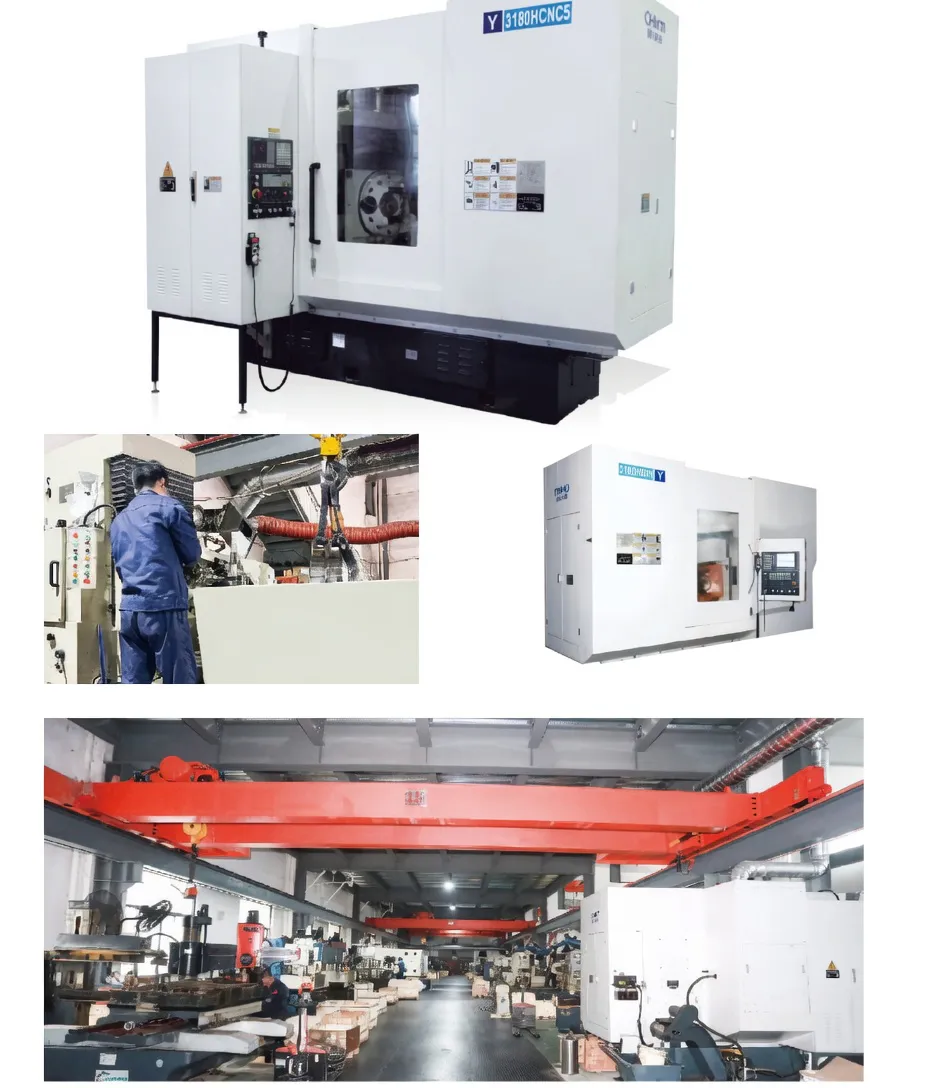
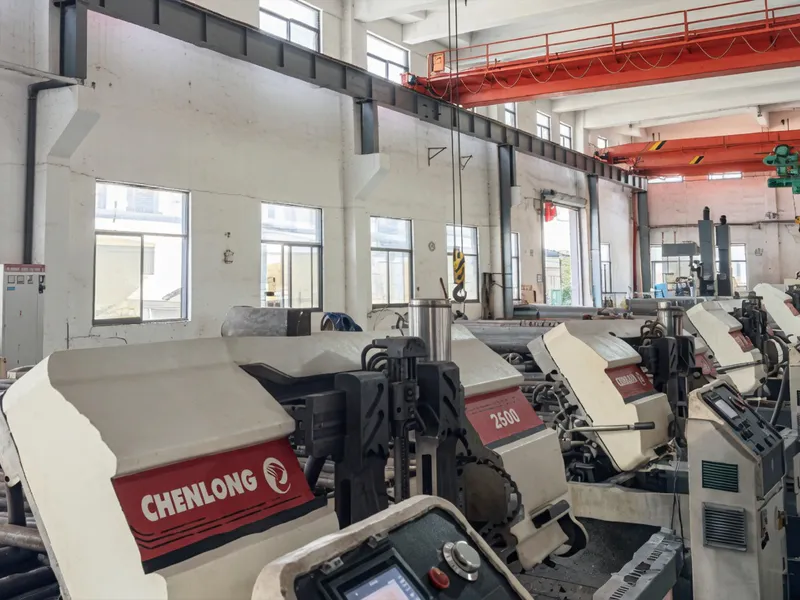
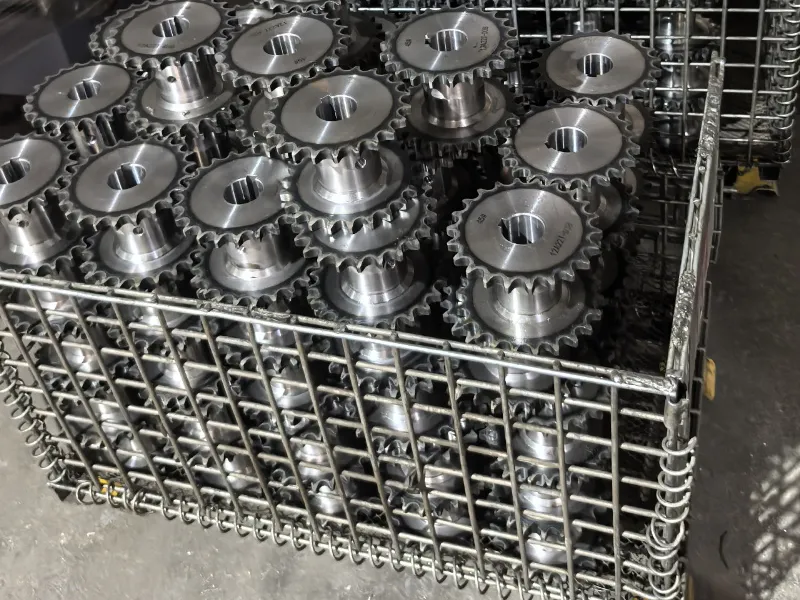
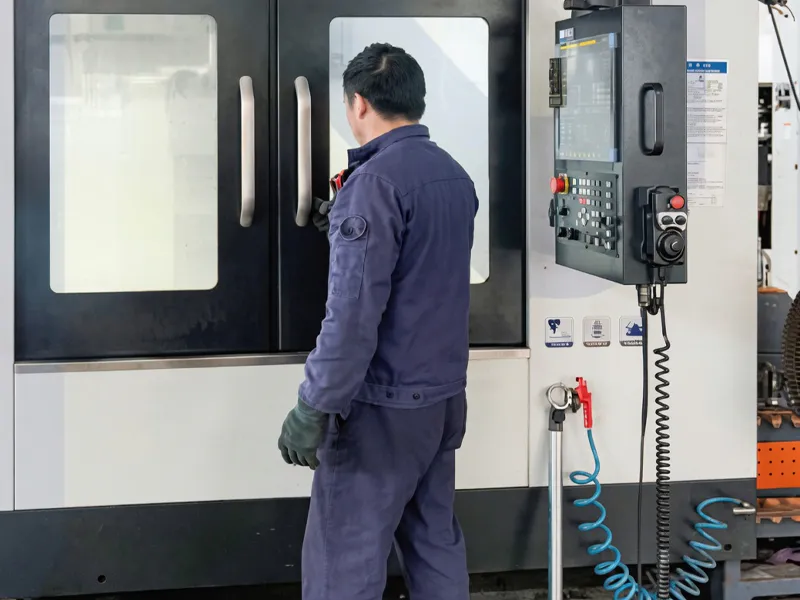
Since 2010, our production facility has accumulated more than fifteen years of focused experience in precision roller chain sprockets and gear components built to the full suite of international dimensional standards — ANSI/ASME B29.1, DIN 8187 / ISO/R 606, and JIS B 1801. Our machining floor runs CNC hobbing centres, profile-grinding stations, and coordinate measuring machines in a continuous production environment that holds tooth profile tolerances to ANSI quality grades across complete production batches, not just sampled inspection pieces.
Every American sprocket leaving our facility carries a verified tooth profile against ANSI B29.1 (or the applicable European or Asian standard), with dimensional records retained for customer OEM technical files. Gear tooth profile accuracy is documented to DIN 3961 / ISO 1328 quality grades. Our product catalogue spans all three major roller sprocket standards — ANSI/ASME, DIN/ISO, and JIS — plus a full gear range per DIN 782 including spur gears, bevel gears, and racks — making us a genuine single-source commercial gear and sprocket partner for multi-standard OEM programmes. For industrial buyers across Colombia, the Americas, and global markets, our combination of full-range stock bore inventory and custom machining capability serves both immediate replacement and planned production requirements without minimum order restrictions on established part numbers.
Workshop
8. Compatible Drive System Components
A double-strand sprocket reaches its rated performance only when paired with the correct chain and reducer specification. We supply matched system components from the same manufacturing framework, removing the compatibility uncertainty that arises from multi-supplier procurement across different catalogues and standards.
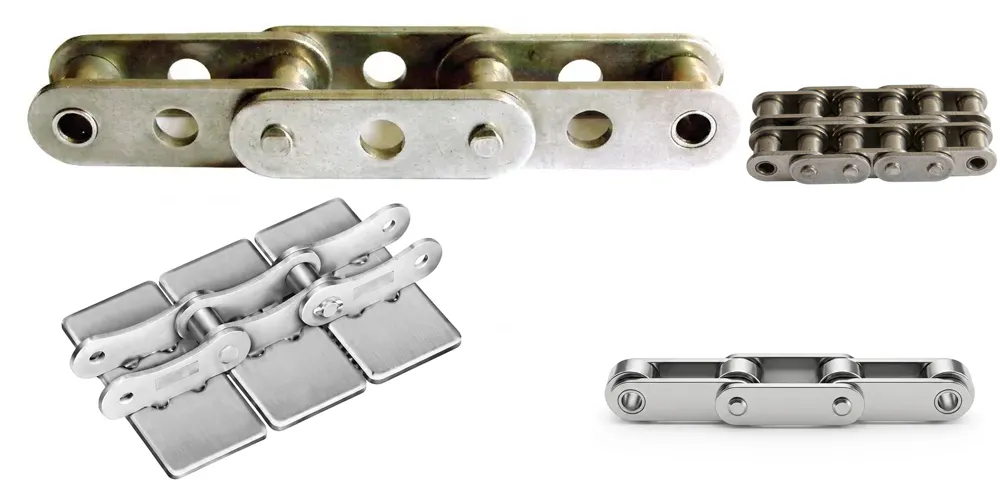
ANSI No.100 Double-Strand Roller Chain
The No.100-2 sprocket must be paired with a No.100 double-strand roller chain conforming to ANSI B29.1. The chain pitch (1¼ inch), roller diameter (0.750 inch), and inner link width must all fall within the ANSI tolerance window that governs the tooth pocket geometry — using a single-strand or triple-strand chain on a double-strand sprocket produces immediate lateral misalignment and load imbalance. Our roller chains are manufactured to the same ANSI B29.1 standard as the No.100-2 sprocket series, with each dimensional parameter within the tolerance window governing correct engagement. For buyers in Colombia and North America sourcing chains and sprockets as a matched No.100-2 set, a single combined conformance declaration can be provided covering both the chain and sprocket dimensions — simplifying incoming quality inspection for managed procurement operations.
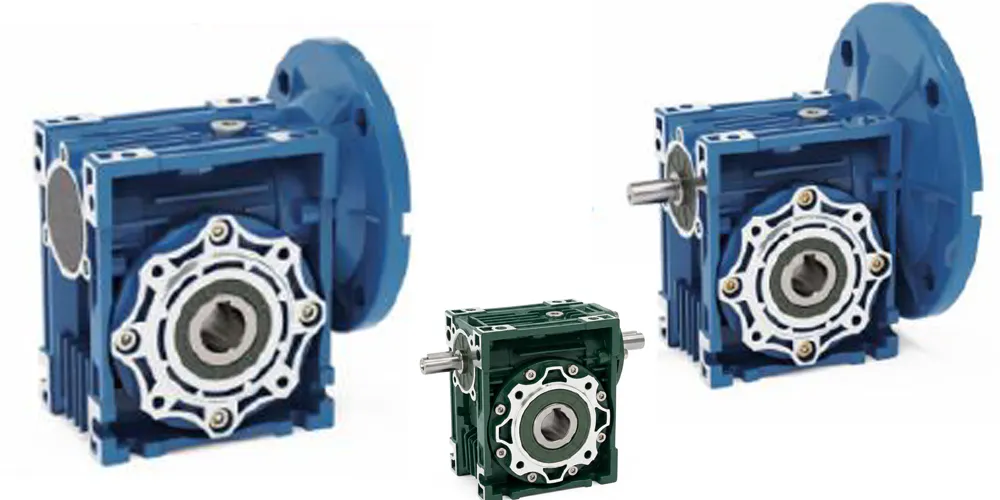
Riduttore a vite senza fine NMRV
The majority of No.100-2 chain drives receive their speed reduction through a worm gear reducer between the motor and the drive sprocket shaft. Our NMRV worm gear reducers are available in output shaft diameters and keyway configurations that pair directly with the bore range across the No.100-2 series — from the 1-inch minimum bore at Z=9 up to the 5⅞-inch maximum bore at the large Type C sizes. Specifying sprockets and reducer from a single supplier allows our engineering team to confirm drive shaft diameter, keyway dimensions, and output speed against the sprocket specification before delivery — eliminating the fit mismatches that most commonly surface during commissioning when components are sourced from separate catalogues. For gears and sprockets near me buyers across Colombia and the Americas, this one-stop approach consolidates vendor management and reduces procurement coordination effort on both planned builds and emergency replacement programmes.
Domande frequenti
Gamma completa di pignoni americani disponibile
Browse the complete series — all ANSI pitch sizes, hub configurations, stock bore, and custom OEM options.
Redattore: PXY