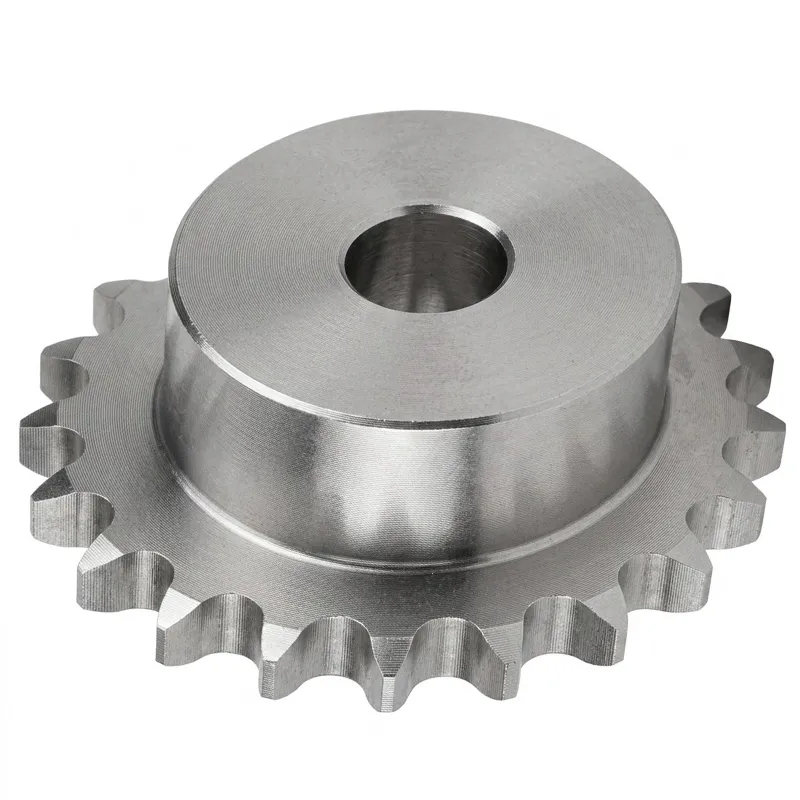
EP-6×2.8mm 欧洲链轮 — 04B-1 型
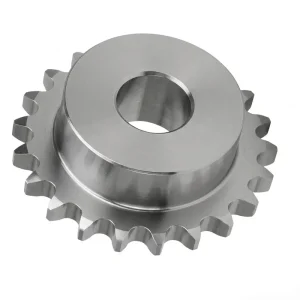
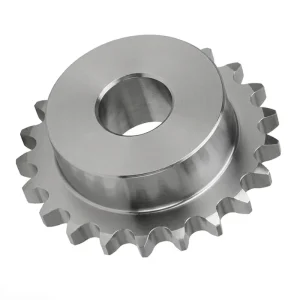
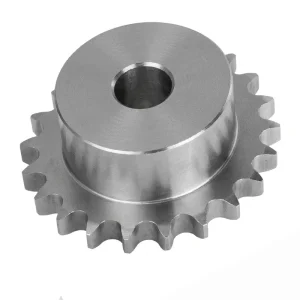
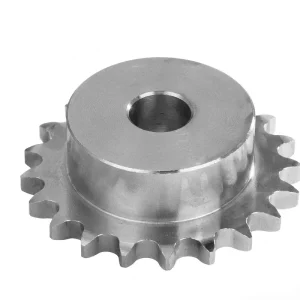
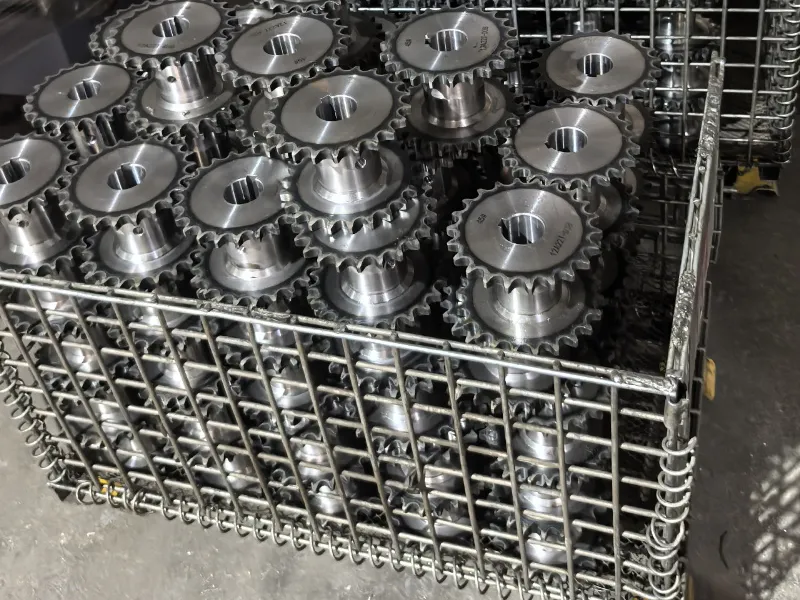
The Type 04B-1 European Sprockets are precision-engineered for power transmission systems, designed to mate seamlessly with 6×2.8mm pitch chains according to DIN 8187 and ISO/R 606 standards. This simplex series features a robust tooth profile with a 6mm tooth radius and 2.6mm tooth width, ensuring smooth engagement and reduced wear. Available in a comprehensive range from 8 to 125 teeth, these sprockets offer versatile compatibility for various industrial applications. Key dimensions include bore options (dm) ranging from 9.8mm to 70mm and hub diameters (D1) from 5mm to 70mm depending on the tooth count. Notably, for models with 66 teeth or more, the plate thickness increases to 4mm for enhanced durability under heavy loads. These sprockets are ideal for demanding mechanical drives requiring reliable performance and strict adherence to European manufacturing standards.
EP-6×2.8mm 欧洲链轮 — 04B-1 型
Precision-engineered for DIN 8187 and ISO/R 606 compliance, the EP 6×2.8mm European Sprockets series delivers consistent, reliable performance in demanding industrial chain drive applications. Whether you are sourcing replacement European sprockets for food processing lines in Colombia, upgrading a packaging conveyor across European facilities, or specifying OEM components for agricultural machinery, this series provides the dimensional accuracy, material integrity, and standards traceability that modern engineering projects require. With tooth counts spanning from Z=8 up to Z=125, and simplex configuration fully documented per DIN specifications, these European standard sprockets are a dependable choice across a broad spectrum of power transmission environments worldwide.
Designed as part of the European Sprockets Series, the 04B-1 range is manufactured with controlled tooth-profile geometry, validated bore dimensions, and hub parameters built to accommodate real-world installation tolerances. Each sprocket in this lineup pairs directly with 6mm pitch roller chain — pitch internal width 2.8mm, roller diameter 4mm — and is engineered to satisfy both stock-replacement and custom OEM requirements without dimensional compromise.
1. Technical Specifications — EP 04B-1 European Sprockets (6×2.8mm Simplex)
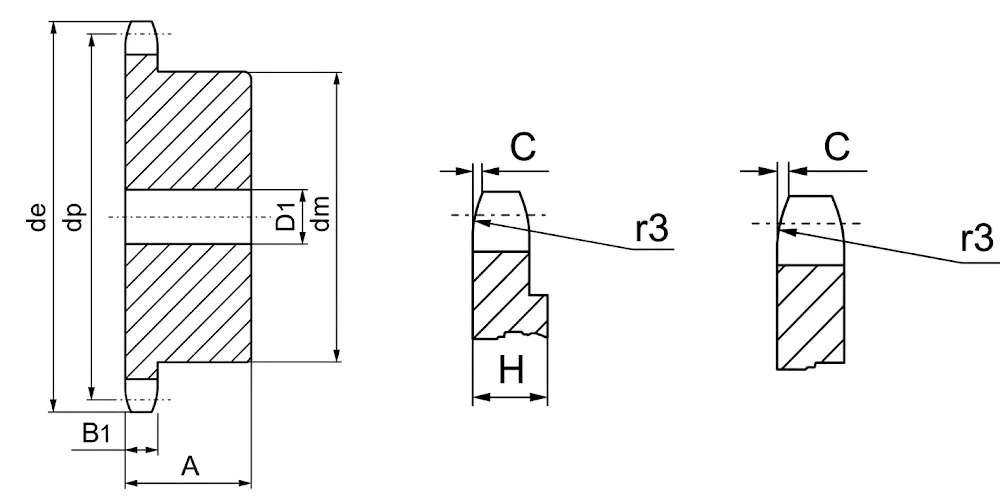
The table below lists the complete dimensional data for the 04B-1 range. All dimensions in millimetres. d₃ = Tip circle diameter; dₚ = Pitch circle diameter; dₕ = Hub bore diameter (standard stock); D₁ = Bore diameter; A = Hub width (mm). Note: from Z=66, plate width A increases to 30mm.
| Z | d₃ (mm) | dₚ (mm) | dₕ (mm) | D₁ (mm) | A (mm) |
|---|---|---|---|---|---|
| 8 | 18.0 | 15.67 | 9.8 | 5 | 10 |
| 9 | 19.9 | 17.54 | 11.5 | 5 | 10 |
| 10 | 21.7 | 19.42 | 13 | 6 | 10 |
| 11 | 23.6 | 21.30 | 14 | 6 | 10 |
| 12 | 25.4 | 23.18 | 16 | 6 | 10 |
| 13 | 27.3 | 25.05 | 18 | 8 | 10 |
| 14 | 29.2 | 26.96 | 20 | 8 | 10 |
| 15 | 31.0 | 28.86 | 20 | 8 | 10 |
| 16 | 33.0 | 30.76 | 20 | 8 | 13 |
| 17 | 35.0 | 32.65 | 20 | 8 | 13 |
| 18 | 36.9 | 34.55 | 20 | 8 | 13 |
| 19 | 38.8 | 36.44 | 20 | 8 | 13 |
| 20 | 40.7 | 38.34 | 20 | 8 | 13 |
| 21 | 42.6 | 40.25 | 25 | 8 | 13 |
| 22 | 44.5 | 42.16 | 25 | 8 | 13 |
| 25 | 50.2 | 47.87 | 25 | 8 | 13 |
| 30 | 59.8 | 57.42 | 30 | 8 | 15 |
| 38 | 75.0 | 72.66 | 30 | 8 | 15 |
| 40 | 78.9 | 76.47 | 30 | 8 | 15 |
| 45 | 88.5 | 86.01 | 40 | 8 | 18 |
| 50 | 98.0 | 95.55 | 40 | 8 | 18 |
| 57 | 111.4 | 108.93 | 40 | 8 | 18 |
| 60 | 117.1 | 114.62 | 50 | 8 | 20 |
| 65 | 126.6 | 124.18 | 50 | 8 | 20 |
| 72 | 140.0 | 137.55 | 50 | 8 | 20 |
| 76 | 147.6 | 145.19 | 50 | 8 | 20 |
| 80 | 155.3 | 152.82 | 70 | 8 | 30 |
| 90 | 174.4 | 171.92 | 70 | 8 | 30 |
| 100 | 193.5 | 191.01 | 70 | 8 | 30 |
| 110 | 212.6 | 210.11 | 70 | 8 | 30 |
| 120 | 231.7 | 229.20 | 70 | 8 | 30 |
| 125 | 241.2 | 238.75 | 70 | 8 | 30 |
Note: H = 4 mm. From Z=66 the width of the plate is increased to 30 mm. For full range Z=8 through Z=125 and intermediate tooth counts not shown above, contact us for the complete dimensional datasheet.
2. What Are 6×2.8mm European Standard Sprockets?
The 6×2.8mm European sprockets designation refers to a specific sub-family within the broader European Sprockets Series. The first number — 6 — denotes the chain pitch in millimetres, while 2.8mm describes the chain's internal width. These two parameters define the chain profile that the sprocket teeth must exactly accommodate. Chain sprockets in this family are catalogued under the 04B-1 reference and comply with DIN 8187 as well as the internationally harmonised ISO/R 606 document, which governs roller chain dimensions across European and international markets.
Unlike ANSI or JIS counterparts, European standard sprockets follow DIN-defined tooth geometry — a flanked involute tooth form with radius-defined flanks, controlled tip circle diameters (d₃), and pitch circle diameters (dₚ) calculated per established formulae. This geometry ensures that when the sprocket engages the chain's roller, contact stress is distributed uniformly, minimising wear on both the chain's rollers and the sprocket teeth. For engineers working on machines distributed across Germany, Spain, Colombia, or other markets where DIN/ISO documentation is the accepted procurement baseline, specifying European sprockets simplifies cross-border spare-parts management significantly.
The practical range of the 04B-1 series runs from an 8-tooth minimum sprocket — with a tip circle diameter (d₃) of 18.0mm and pitch circle diameter (dₚ) of 15.67mm — through to a 125-tooth sprocket at d₃ = 241.2mm and dₚ = 238.75mm. This breadth makes it possible to realise a wide range of speed-reduction ratios within a single product family, reducing the design complexity that would otherwise arise from mixing multiple chain standards on a single machine.
3. Five Key Advantages of These European Sprockets
Every tooth profile, bore tolerance, and hub dimension in this range is verified against DIN 8187 and ISO/R 606 acceptance criteria before leaving the production floor. This means the sprocket will mate precisely with any conforming 04B-1 roller chain without requiring field adjustment, making commissioning faster and warranty claims easier to handle. For procurement teams across Colombia, Germany, and broader European markets, documented standards compliance simplifies approval workflows.
With tooth counts from Z=8 to Z=125, the 6×2.8mm European sprockets series accommodates an exceptionally broad selection of drive ratios within a single standard. Design engineers can pair low-tooth-count drive sprockets with large-count driven sprockets to achieve compact, high-ratio transmissions — or use near-equal tooth counts for synchronised low-reduction conveyance drives. This single-family flexibility reduces the number of distinct standards a maintenance team needs to stock.
Production centres equipped with multi-axis CNC machining hubs hold tooth-flank tolerances tightly across the full tooth-count range. CNC control eliminates the profile deviations common in older hobbing-only processes, producing a tooth geometry that engages the chain roller smoothly through the full wrap angle. Reduced polygon effect and uniform roller entry translate directly into quieter operation and extended sprocket life — a measurable benefit in 24-hour production environments where downtime is costly.
Standard stock items within the 04B-1 European sprockets range are available for rapid dispatch, supporting urgent replacement requirements with minimal lead time. The same production infrastructure handles fully customised engineering variants — modified bores, keyways, set-screw bosses, non-standard hub lengths, and surface treatments — without requiring a separate supplier relationship. OEM machinery builders and MRO procurement teams both benefit from this integrated supply model, which eliminates the inconsistency that arises when standard and custom parts come from different sources.
Production is conducted under an integrated management system certified to ISO 9001 (quality), ISO 14001 (environment), and ISO 45001 (occupational health and safety). Triple accreditation signals to procurement auditors and machine-builders alike that process controls, traceability records, and corrective-action procedures meet globally recognised benchmarks — not just a single territorial standard. For industrial buyers in Colombia and across Europe who require documentation packages for machine CE marking or equipment safety records, this certification level provides meaningful reassurance.
4. How 6×2.8mm European Sprockets Work
At its core, a roller chain sprocket functions as a positive-engagement drive element. When the chain wraps around the sprocket, each link's roller seats into the sprocket tooth valley. As the sprocket rotates — driven by a motor shaft, gearbox output, or hand-actuated mechanism — the teeth push on the rollers, transferring torque from the shaft into linear motion in the chain strand. Because engagement is mechanical and direct, there is no slip, making chain-and-sprocket drives well-suited to applications requiring exact speed ratios and reliable synchronisation.
The 04B-1 European sprockets geometry governs three critical engagement parameters. First, the pitch circle diameter (dₚ) determines where the chain rollers sit relative to the shaft centre, establishing the velocity ratio between meshing sprockets. Second, the tooth radius r₃ = 6mm and the tooth width B₁ = 2.6mm define the flank shape that wraps around each roller during engagement — too tight a fit increases roller wear; too loose allows chordal impact. Third, the tip-to-tip outside diameter (d₃) prevents the chain from riding up over the teeth under shock loads. Together, these parameters — all specified in the DIN 8187 / ISO/R 606 framework — ensure smooth engagement, predictable fatigue life, and interchangeability across conforming suppliers.
It is also worth noting the plate-width transition built into this series: from Z=66 upward, the hub plate width A increases to 30mm. This structural adaptation accommodates the higher bending moments generated as the pitch circle diameter grows, preserving the stiffness-to-weight ratio across the full tooth-count range and preventing hub-face deflection that would otherwise accelerate chain-side plate wear.
5. Material Construction
The standard production material for the 04B-1 European sprockets range is medium-carbon steel — typically C45 or equivalent — selected for its combination of machinability and achievable case-hardness after heat treatment. Sprockets supplied in this grade undergo induction hardening at the tooth flanks and root, reaching surface hardness values in the range of 50–58 HRC while retaining a tougher, more ductile core. This hardness gradient is intentional: the hard surface resists roller-induced abrasion, while the softer core absorbs shock loads without cracking — a failure mode that pure-hardened components are vulnerable to under reversing or impact loads.
For environments where corrosion is a design concern — wet food-processing facilities, outdoor agricultural installations in tropical climates, or chemical-handling conveyors — stainless steel sprockets and gears are available as an alternative material specification. Stainless steel sprockets and gears in grades such as AISI 304 or AISI 316 offer substantially improved resistance to rust and chemical attack compared to carbon steel, at the cost of somewhat reduced surface hardness. For lighter-load, corrosion-critical applications such as conveyors in Colombian flower-export processing plants or European pharmaceutical packaging lines, the stainless option is a well-established engineering practice.
In addition to the two primary material families, engineering-grade plastic sprockets and gears — typically manufactured from acetal (POM) or nylon (PA66) — are also produced for specific low-load, noise-sensitive, or self-lubricating applications. Plastic sprockets and gears eliminate the risk of metal contamination in food or pharmaceutical contexts, though their load and temperature ratings are necessarily more conservative than steel variants. Material selection guidance is available upon request for any specific application context.
Surface treatment options beyond induction hardening include phosphating, black oxide coating (producing black sprockets suitable for low-moisture environments), and electroless nickel plating. Each treatment modifies the part surface differently in terms of corrosion resistance, lubrication retention, and dimensional effect — and selection should be matched to the expected operating conditions and lubrication regime.
6. Application Scenarios for 6×2.8mm European Sprockets
The small pitch and compact roller geometry of the 04B-1 European sprockets series makes it a natural fit for precision-critical, moderate-load drive applications. Below are several specific fields where these industrial sprockets and gears see regular deployment.
Diagnostic imaging platforms, laboratory centrifuge indexing drives, and automated sample handling systems frequently use 6mm pitch European sprockets where positioning accuracy and smooth operation matter more than raw power density. The compact footprint allows integration into tight enclosures, and stainless steel or plastic material options satisfy sterilisation and contamination-control requirements common in European healthcare equipment standards.
Filling machines, labelling systems, and portion-control conveyors in food processing facilities rely on roller chain sprockets for precise indexing between stations. In Colombian agro-industrial facilities — particularly in fruit sorting, coffee processing, or flower packaging — 04B-1 European sprockets pair reliably with 6mm pitch chains to drive lightweight conveyor belts and indexing drums. Stainless steel sprockets and gears are preferred in zones subject to wash-down procedures or exposure to fruit acids and cleaning agents.
Sheet-fed and web-fed printing presses, die-cutting machines, and paper slitting lines use small-pitch European sprockets to synchronise rollers, impression cylinders, and web tension systems. The fine pitch allows accurate tension control and low noise levels at the moderate speeds typical of these machines. Germany and Spain have historically been major producers of printing machinery, and DIN-compliant European sprockets facilitate maintenance compatibility across equipment generations from multiple manufacturers.
Small seed drills, transplanting machines, greenhouse curtain drives, and nursery conveyors are common applications for 6mm pitch roller chain sprockets in the agricultural sector. In Colombia, where greenhouse floriculture is a significant export industry, this size class of European sprockets sees regular use in irrigation control mechanisms and pot-moving systems. Their light weight, compact chain gears and sprockets geometry, and ease of replacement support the demanding maintenance environments typical of working farm equipment.
Multi-function printers, automated document feeders, vending machine dispensing mechanisms, and currency handling equipment all involve light-duty chain and sprocket drives where compactness and low noise are design priorities. The 04B-1 European sprockets family, with tooth counts as low as Z=8 producing very small pitch-circle diameters, fits naturally into the confined spaces typical of office machines and self-service equipment deployed across Europe and Latin America.
Weaving looms, knitting machines, and sewing machine feed mechanisms have a long history of employing small-pitch European sprockets for yarn-guide drives, pattern-cam indexing, and fabric-advance mechanisms. DIN-compliant sprockets germany-style are a natural specification here, as much of the world textile machinery heritage traces to European engineering traditions where DIN standards were established as baseline. Replacement sprocket sourcing that references the same DIN 8187 standard used at the original equipment manufacturer level simplifies maintenance documentation across multi-site textile operations.
7. Regulatory and Standards Context by Region
European Union — Machinery Directive 2006/42/EC & EN ISO Standards
Within the EU, machinery incorporating chain drive components must comply with the Machinery Directive 2006/42/EC (set to be superseded by the Machinery Regulation (EU) 2023/1230, effective from 2027). Sprocket standards DIN 8187 and ISO/R 606 are accepted harmonised reference norms under this framework. Designers of CE-marked machines incorporating European sprockets are expected to document sprocket selection, load calculations, and material certification as part of the Technical File. EN ISO 4414 (pneumatic fluid power) and EN ISO 4413 (hydraulic fluid power) also intersect with drive system design where chain-driven actuators are involved.
Germany — DIN Standards
Germany is the origin jurisdiction for DIN 8187, the primary standard defining European roller chain and sprocket geometry. German industrial buyers and technical specifications frequently reference DIN standards as the acceptance baseline. DIN 3961 / ISO 1328 governs gear tooth accuracy documentation and applies to the broader family of industrial sprockets and gears produced under the same quality management system as these sprockets germany-market products.
Colombia — ICONTEC and Machinery Import Regulations
In Colombia, the national standards body ICONTEC (Instituto Colombiano de Normas Técnicas y Certificación) adopts and adapts ISO standards for domestic application. Machinery imported into Colombia must comply with INVIMA regulations where food-contact equipment is involved, and with RETIE (Reglamento Técnico de Instalaciones Eléctricas) where electrically driven chain conveyors are concerned. For general industrial sprocket procurement in Colombia, ISO-compliant documentation — the same basis as DIN 8187 / ISO/R 606 — is recognised by Colombian engineering buyers and customs documentation officers. Industrial buyers sourcing European sprockets for sale in Colombia are advised to request ISO conformity declarations alongside shipment documentation.
United Kingdom — Post-Brexit UKCA Marking
Since January 2021, machinery placed on the UK market requires UKCA marking under the UK Machinery Directive (SI 2008/1597 as amended). For drive components including industrial chains and sprockets, the underlying dimensional and safety standards remain aligned with their EU/ISO equivalents, meaning DIN 8187-compliant European standard sprockets continue to serve as technically appropriate components in UK-market equipment. Supply chains sourcing best European sprockets for UK machinery OEMs should ensure that conformity documentation specifies UKCA as well as CE where equipment is dual-marketed.
ISO International Harmonisation
ISO/R 606 and its successor ISO 606 form the international baseline for roller chain and sprocket specifications globally. For buyers outside Europe and Colombia — including markets in Southeast Asia, the Middle East, and Africa where DIN-derivative standards are commonly referenced in technical specifications — ISO 606 documentation provides the conformity basis that international procurement procedures typically require. Products in this range carry dimensional traceability to ISO/R 606 as stated in the product designation.
8. Compatible Products — System Compatibility and One-Stop Supply
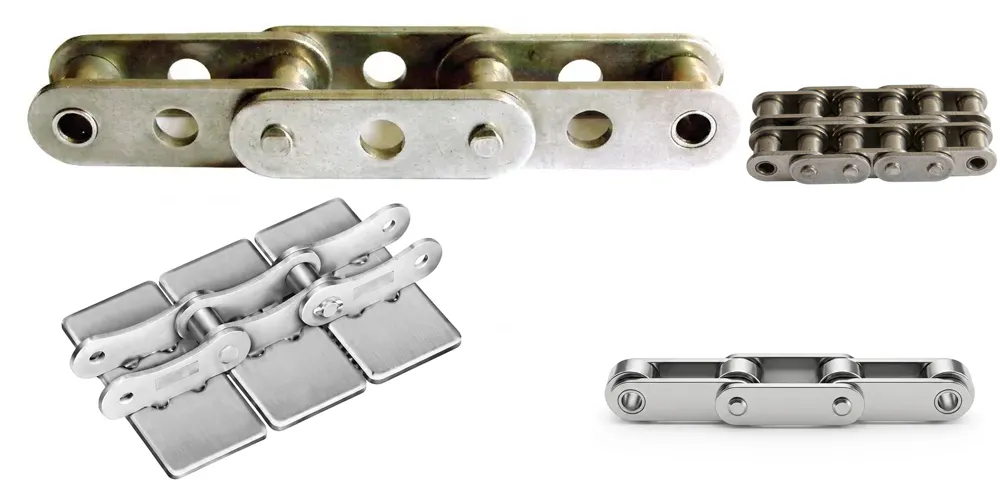
European sprockets do not operate in isolation — their performance is directly linked to the quality of the chain and the drive system components connected to them. We produce matched components across the full drive system, which means the dimensional compatibility is engineered from the outset rather than assumed.
The 04B-1 European sprockets in this range are designed to run with 6mm pitch roller chain conforming to DIN 8187 and ISO/R 606. Sourcing chain from the same supply ecosystem as the sprocket eliminates the dimensional uncertainty that can arise when mixing chain and sprocket from separate standards interpretations. Our roller chain production covers European DIN/ISO, ANSI/ASME, and JIS pitch families for complete industrial chains and sprockets coverage.
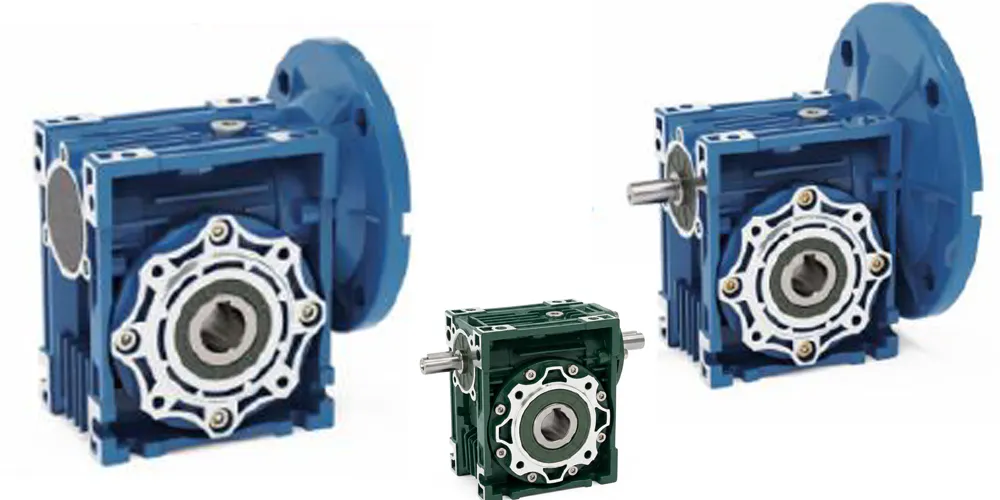
For applications where the chain-and-sprocket drive connects to a motor through a speed-reduction stage, NMRV worm gear reducers are a commonly specified option in the European industrial market. The NMRV reducer provides compact, right-angle speed reduction at an economical price point, and its standardised output shaft dimensions align well with the bore range of the 04B-1 European sprockets series. Combining a reducer with a correctly selected sprocket pair allows the engineer to achieve the required chain speed and torque from a standard motor without custom shafting.
9. About Us - European Sprocket Manufacturer
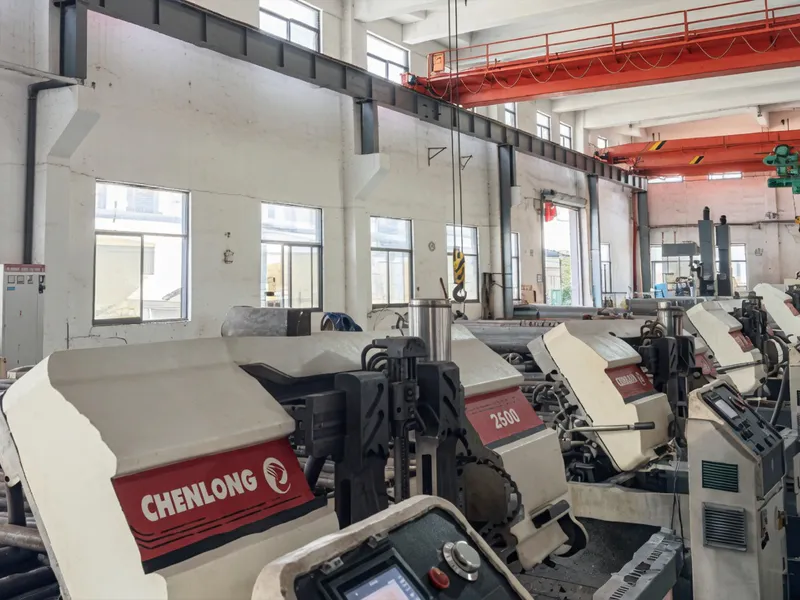
Our journey in precision power transmission components began in 2010 — over a decade and a half of continuous manufacturing experience that informs every product we produce today. We specialise in roller chain sprockets and gears built to international standards, operating a production facility equipped with modern CNC machining centres that hold tooth-profile tolerances to DIN-standard quality levels throughout the full production run, not just on first-article samples.
Tooth profile geometry for every sprocket leaving our facility is verified against the applicable standard — DIN 8187, ANSI B29.1, or JIS B 1801, depending on which chain standard the component is designed for. Gear tooth accuracy is documented in accordance with DIN 3961 / ISO 1328 quality levels, giving engineering buyers a clear, auditable trail from raw material through finished inspection. Our product portfolio spans all three major roller chain sprocket standards — European DIN/ISO, American ANSI/ASME, and Asian JIS — as well as a comprehensive gear range including spur gears, bevel gears, and racks conforming to DIN 782.
车间
Frequently Asked Questions
Editor: PXY