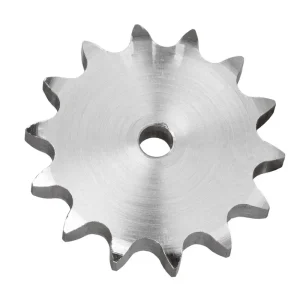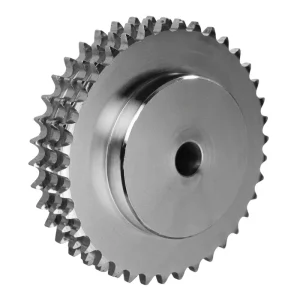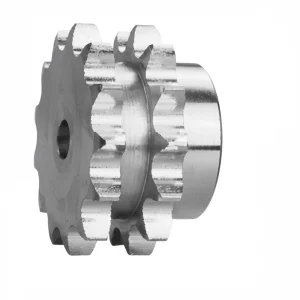
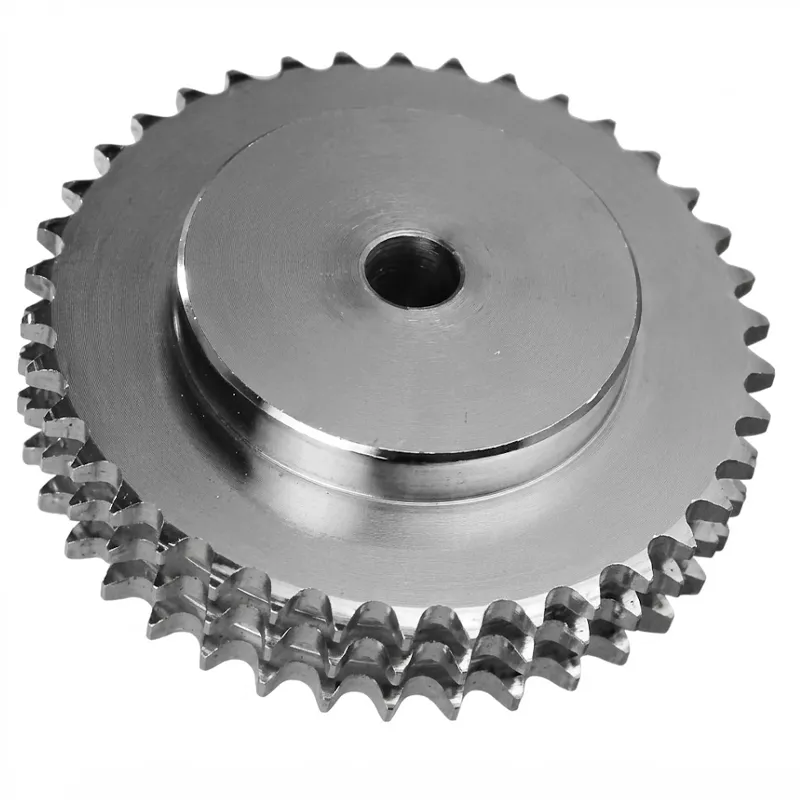
EP ⌀0.75″ Triple-Strand American Sprocket — No.100-3 سیریز
The “-3” suffix in the No.100-3 designation follows the ANSI convention for multi-strand roller chain sprockets, where the number after the hyphen indicates the strand count: No.100-1 is single-strand, No.100-2 is duplex, and No.100-3 — this product — is triplex. A triplex configuration carries three parallel strands of #100 chain side by side, engaging all three simultaneously as the hub rotates. The torque capacity of the drive scales approximately with strand count: a No.100-3 installation transmits roughly three times the torque of a single-strand No.100 drive using identical chain, identical pitch, and the same shaft centre distance.
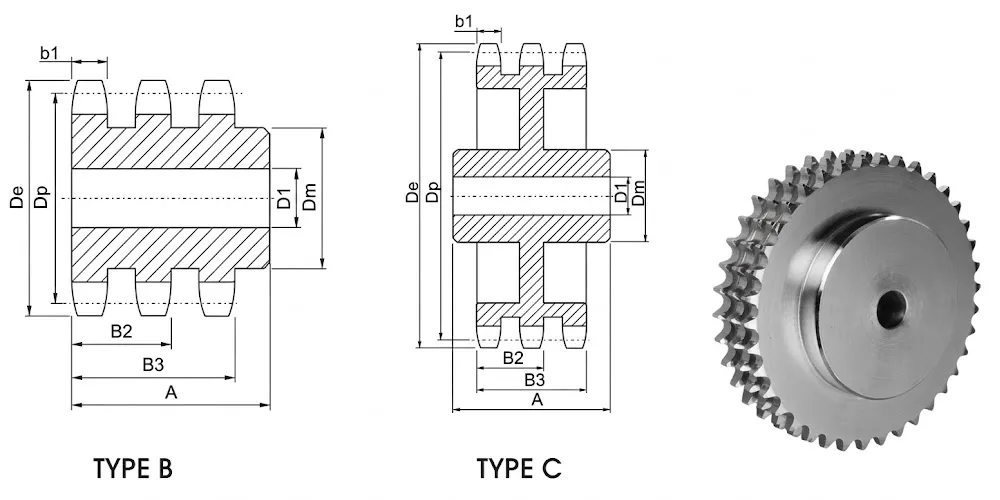
Hub types are limited to Type B and Type C for the No.100-3. No Type A (simple through-bore) is offered in the triplex format because the hub bending moment from three strands of #100 chain tension is too high for a simple plate hub. Type B in this triplex American sprocket provides a flanged hub boss with defined Dm (hub outer diameter) and A (hub width) values; Type C extends the hub geometry further for higher bore capacity and greater shaft engagement length. This structural requirement is not unique to this product — it is a consistent design principle across all heavy ANSI triplex families: when strand count and chain load multiply, hub engagement depth must scale accordingly.
EP ⌀0.75" Triple-Strand American Sprocket — No.100-3 Series
The EP No.100-3 is a triple-strand American sprocket — meaning it runs three parallel #100 roller chains simultaneously on a single hub. Built to ANSI/ASME B29.1, the No.100-3 American sprocket shares its chain pitch (1-1/4" / 31.75 mm) and roller diameter (0.750" / 19.05 mm) with the single-strand No.100 family, but its defining dimensional parameters are the three tooth width values: b1 = 0.669" (the individual strand tooth width), B2 = 2.077" (the combined two-inner-strand measurement), and B3 = 3.485" (the full triplex hub width). Together, three strands of No.100 chain on this American sprocket approximately triple the torque capacity of a single-strand installation without requiring any change to shaft centre distances, chain pitch, or drive housing geometry. For engineers in the United States, Colombia, and other ANSI-standard markets who have exhausted the load capacity of a single-strand drive in a given pitch, the No.100-3 is the direct engineering answer.
The product range covers tooth counts from 11 through 80 in Type B (flanged hub) and Type C (extended hub) constructions — no Type A exists in triplex format, because the hub engagement requirements of a triple-strand American sprocket always demand the more substantial hub cross-sections that Types B and C provide. Part numbers follow the ANSI E-series triplex convention: E100B11 (Type B, 11 teeth) through E100C80 (Type C, 80 teeth). Stock bore units in common tooth counts are available for rapid dispatch; custom bore, extended hub, and surface treatment options are produced to order using the same CNC machining infrastructure.
1. تکنیکی تفصیلات کے پیرامیٹرز
Full dimensional table for EP No.100-3 Triple-Strand American Sprocket. De = tip circle diameter ("); D1 Min/Max = bore range; Dm = hub OD ("); A = hub width ("). All bore dimensions in inches.
| Teeth | Part No. | De (") | قسم | D1 Min (") | D1 Max (") | Dm (") | A (") | Wt (lb) |
|---|---|---|---|---|---|---|---|---|
| 11 | E100B11 | 5.010 | بی | 1 | 2-5/8 | 3-3/8 | 4-3/4 | 11.7 |
| 12 | E100B12 | 5.420 | بی | 1-1/8 | 2-3/4 | 3-3/8 | 4-3/4 | 13.7 |
| 13 | E100B13 | 5.820 | بی | 1-1/8 | 2-1/2 | 3-3/16 | 4-3/4 | 16.9 |
| 14 | E100B14 | 6.230 | بی | 1-1/8 | 2-3/4 | 4-3/16 | 4-3/4 | 20.2 |
| 15 | E100B15 | 6.630 | بی | 1-1/4 | 3-3/8 | 4-7/8 | 4-1/2 | 25.0 |
| 16 | E100B16 | 7.030 | بی | 1-1/4 | 3-9/16 | 5 | 4-1/2 | 29.3 |
| 17 | E100B17 | 7.440 | بی | 1-1/4 | 3-1/2 | 5-1/4 | 4-1/2 | 33.8 |
| 18 | E100B18 | 7.840 | بی | 1-1/4 | 3-1/2 | 5-1/4 | 4-3/4 | 38.6 |
| 19 | E100B19 | 8.240 | بی | 1-1/4 | 3-3/4 | 5-1/2 | 4-3/4 | 43.3 |
| 20 | E100B20 | 8.640 | بی | 1-1/4 | 3-3/4 | 5-1/2 | 4-3/4 | 47.9 |
| 21 | E100B21 | 9.040 | بی | 1-1/4 | 3-3/4 | 5-1/2 | 4-3/4 | 52.3 |
| 22 | E100B22 | 9.440 | بی | 1-1/4 | 3-3/4 | 5-1/2 | 4-3/4 | 57.5 |
| 23 | E100B23 | 9.840 | بی | 1-1/4 | 3-3/4 | 5-1/2 | 4-3/4 | 62.5 |
| 24 | E100B24 | 10.250 | بی | 1-1/4 | 3-3/4 | 5-3/4 | 4-3/4 | 69 |
| 25 | E100B25 | 10.650 | بی | 1-1/4 | 3-3/4 | 5-3/4 | 4-3/4 | 73 |
| 26 | E100B26 | 11.050 | بی | 1-1/2 | 3-13/16 | 5-3/4 | 4-3/4 | 79 |
| 30 | E100B30 | 12.640 | بی | 1-1/2 | 3-13/16 | 5-3/4 | 4-3/4 | 103 |
| 35 | E100C35 | 14.640 | سی | 1-1/2 | 4 | 6 | 5 | 108 |
| 45 | E100C45 | 18.630 | سی | 1-1/2 | 4 | 6 | 5 | 143 |
| 60 | E100C60 | 24.600 | سی | 1-1/2 | 5-5/8 | 7-1/2 | 5 | 217 |
| 70 | E100C70 | 28.580 | سی | 1-1/2 | 5-5/8 | 7-1/2 | 5 | 262 |
| 80 | E100C80 | 32.570 | سی | 1-1/2 | 5-5/8 | 7-1/2 | 5 | 313 |
Maximum bores shown accommodate standard keyseat and setscrew over keyseat. Slightly larger bores are possible with no keyseat, shallow keyseat, or setscrew at angle to keyseat. Contact us for all intermediate tooth counts (11 through 80).
2. Five Key Advantages of the No.100-3 American Sprocket
The most practical advantage of the No.100-3 American sprocket is that three parallel chain strands multiply torque capacity approximately threefold versus a single-strand installation — while keeping the chain pitch, shaft centre distance, and sprocket pitch circle diameter completely unchanged. For engineers who have designed a drive around No.100 chain and subsequently need more torque — due to increased product weight, faster throughput, or added conveyor sections — switching from a single-strand drive to this triple-strand configuration requires changing only the sprockets and adding two additional chain strands. No new housing, no new shaft calculation, no chain pitch redesign. This is why double chain sprocket gear and triple-strand configurations are a preferred upgrade path in heavy industrial conveyor engineering.
All dimensional parameters — b1, B2, B3, pitch circle diameter, tooth profile seating curve — conform to ANSI/ASME B29.1 specifications for No.100-3 triple-strand roller chain sprockets. The part numbering follows the E-series ANSI convention (E100B11 through E100C80), which is an internationally recognised identifier system for American standard chain sprockets in this strand count. Procurement teams in the United States, Canada, and Colombia can specify this product using the ANSI part number directly, without requiring additional engineering interpretation. Documentation for OSHA machinery compliance and ANSI B29.1 Technical File requirements is available at order placement.
This product is offered only in Type B (flanged hub) and Type C (extended hub) constructions — by engineering design, not by product limitation. A triple-strand American sprocket generates hub bending moments from three simultaneous chain strand tensions, and those moments require the hub engagement depth and wall thickness that only Types B and C can structurally provide. Type B handles the Z=11 to Z=30 range with Dm values up to 5-3/4" and A values up to 4-3/4"; Type C serves Z=35 through Z=80 with Dm rising to 7-1/2" and A to 5" — hub dimensions appropriate to the shaft diameters and bending load levels typical of heavy industrial conveyor and mining auxiliary drive applications.
Producing a consistent ANSI B29.1-conforming tooth profile across all three strand engagement faces — maintaining b1, B2, and B3 tolerances simultaneously — is a genuine manufacturing challenge that separates CNC-machined product from conventionally hobbed alternatives. Our triple-strand American sprocket production uses multi-axis CNC machining centres that hold all three width dimensions and the tooth seating curve to ANSI tolerance simultaneously, ensuring that load distribution across the three chain strands is as equal as the tooth geometry permits. Unequal tooth width machining leads to one strand carrying disproportionate load — accelerating that strand's chain wear and shortening the overall drive service life.
Commonly specified No.100-3 American sprocket sizes — Type B units at Z=11 to Z=26, and selected Type C tooth counts — are held in stock for immediate dispatch. Custom bore configurations, keyway modifications, and extended hub variants are produced using the same CNC tooling with full dimensional documentation. For OEM machinery builders and industrial maintenance teams in Colombia who need both standard replacement kettenrad zahnrader-equivalent quick-turn items and custom engineered components from the same American sprocket manufacturer, this integrated supply capability eliminates the quality and traceability inconsistency that arises when sourcing the two needs separately from different sprocket manufacturers.
3. How the No.100-3 Triple-Strand American Sprocket Works
An American sprocket transfers power through mechanical engagement between its teeth and the rollers of a roller chain. In a triple-strand configuration, this engagement happens simultaneously across three parallel chain loops running side by side on the same hub. As the drive shaft rotates, the three sets of tooth faces push their respective chain rollers forward in synchrony, pulling all three chain strands and driving the output shaft through the matched triple-strand sprocket on the other end. When the installation is correctly aligned and the three chain strands have equal tension, the transmitted torque is shared approximately equally across the three strand engagements — the mechanical basis for the torque capacity multiplication that makes this configuration a practical engineering choice.
The tooth profile geometry for this American sprocket is governed by ANSI/ASME B29.1 for No.100-3. The individual strand tooth width b1 = 0.669" is the face dimension that each of the three chain inner link plate pairs straddles. This 0.669" width is calibrated for the 0.750" roller of No.100 chain: the roller seats into the tooth pocket arc and rolls against the tooth flank seating curve as the chain enters and exits engagement. B2 = 2.077" represents the combined width of the first and second strand tooth faces plus the inter-strand gap — the dimension that governs alignment of the middle chain strand. B3 = 3.485" is the full hub width from the outer face of strand 1's tooth to the outer face of strand 3's tooth, and it is this dimension that drives housing clearance and shaft shoulder positioning in the drive layout.
A critical alignment requirement distinguishes triple-strand American sprocket drives from single-strand installations: all three chain strands must maintain equal tension throughout the drive's operating range. If one strand is significantly tighter or looser than the others, that strand bears disproportionate load and its rollers will wear the corresponding tooth faces on the American sprocket at a faster rate than the other two. This is why triple-strand drives require careful chain take-up adjustment and — where high precision is critical — roller chain links matched within the same manufacturing lot to minimise length variation between strands. This requirement applies to all multi-strand ANSI sprocket installations across the pitch range.
4. Material and Surface Treatment
C45 medium-carbon steel is the standard production material for the No.100-3 American sprocket. For a triple-strand American sprocket, material selection is even more critical than for a single-strand unit: the combined bending moment on the hub from three chain strand tensions, and the multiplied contact stress at each tooth flank face, place greater structural demand on the base material. C45 provides the tensile strength (600–800 MPa normalised) and machinability for CNC triplex tooth-profile cutting, responding reliably to induction hardening at 50–58 HRC. The hard surface protects against rolling contact wear; the tough core absorbs combined bending and torsional loading without brittle fracture.
When considering what is the best steel for sprockets in a No.100-3 context, C45 with induction-hardened flanks is the well-established industrial answer for continuous-load applications. Alternatives exist: some custom sprocket manufacturer operations produce No.100-3 American sprocket units in alloy steels such as 4140 or 4340 for extreme shock-load applications — oil well pumpjacks, heavy quarry crushers — where the core toughness of plain carbon steel at high hardness levels may be insufficient. These alloy-steel American sprocket variants are produced on a custom basis and should be specified with both core hardness and flank hardness targets defined in the OEM drawing.
Stainless steel sprockets & gears are available in AISI 304 or 316L for No.100-3 American sprocket installations in corrosive environments. The 316L grade is recommended for wash-down zones in Colombian and US food processing facilities where chlorinated cleaning agents are regularly applied. Black oxide treatment offers a mild corrosion deterrent and provides the steel stock sprocket with a distinctive dark finish useful for component identification in dense multi-sprocket drive arrangements. All surface treatment options are RoHS-compliant; SVHC declarations under REACH Regulation are available on request for customers with European regulatory requirements.
C45 Steel (Standard)
Default material for this American sprocket; induction-hardenable tooth flanks for long life
AISI 316L Stainless
Best chloride resistance in stainless steel sprockets & gears for food/chemical environments
AISI 304 Stainless
General corrosion-resistant American sprocket for moderate wash-down duty
Black Oxide
Mild protection; dark finish for dry-indoor American sprocket identification
Alloy Steel (Custom)
4140 / 4340 for extreme shock-load American sprocket applications on request
5. درخواست کے منظرنامے۔
The No.100-3 triple-strand American sprocket is specified wherever a single-strand or duplex No.100 drive has insufficient torque capacity, but upgrading to a larger chain pitch would require redesigning the drive system. The following sectors represent the principal deployment environments for this American sprocket in current industrial practice.
Aggregate processing plants, cement clinker handling conveyors, and steel mill coil transfer conveyors specify the No.100-3 American sprocket at drive head drums where the combined chain tension from a fully loaded conveyor belt requires more strand capacity than a single or duplex American sprocket can provide. The Type C variants at Z=45 to Z=80 — with hub widths up to 5" and Dm values up to 7-1/2" — provide the shaft engagement depth needed for the large conveyor drive shafts typical in these applications. In Colombian cement and aggregate processing facilities where US-standard machinery is common, ANSI B29.1 conformance of these units simplifies the procurement documentation required for equipment installation and maintenance audits.
Large-scale combine harvesters, cane mill primary drives, and cotton gin line shafts use triple-strand American sprocket configurations where the main power transmission stage must handle both continuous high torque and cyclical shock loads from crop material surges. The No.100-3 at mid-range tooth counts — Z=15 to Z=26 for drive sprockets, Z=30 to Z=45 for driven units — covers the ratio range typical of these agricultural main drive stages. In Colombia's sugar-cane and palm-oil processing sectors, where machinery from US and Colombian OEMs both require ANSI-documented spare parts, the E-series ANSI part number of this American sprocket provides unambiguous identification for replacement kettenrad zahnrader procurement from qualified sprocket manufacturers.
Longwall conveyor face drives, dragline bucket chain mechanisms, and mineral processing plant crusher feeder conveyors represent some of the most demanding American sprocket applications in the No.100-3 range. At Z=60 to Z=80 in Type C construction — tip circles of 24.600" to 32.570" and weights of 217 to 313 lb — these are substantial mechanical components in their own right. In Colombia's coal mining regions (Cesar, La Guajira) and gold and nickel extraction operations (Antioquia, Córdoba), ANSI-standard American sprocket components are the specification default for US-brand and international-brand mining equipment, and parts procurement follows ANSI B29.1 dimensional conformity as the acceptance standard.
Pipeline pig launcher conveyors, compressor station auxiliary drives, and oil sands processing plant belt-feeder drives use triple-strand American sprocket units where both high torque and operational reliability over long unserviced intervals are design priorities. The No.100-3 American sprocket in Type B and C configurations — with maximum bore diameters to 5-5/8" in the largest tooth counts — accommodates the shaft diameters typical of oil and gas processing drive equipment. In Colombia's Llanos Orientales and Magdalena Medio oil production regions, ANSI-standard industrial sprockets and gears are the maintenance parts standard for equipment operated by international oil companies whose technical specifications reference ANSI B29.1.
Biomass fuel chain grate stokers, waste-to-energy facility chain conveyors, and ash drag chain systems in power generation plants commonly use No.100-3 American sprocket components for main drive head and return shaft applications. The very slow speed, high sustained tension, and continuous duty cycle of chain grate systems favour the triple-strand American sprocket format: the three strands distribute wear across more total link contacts, extending the period between major drive overhauls. Type C American sprocket units at Z=35 to Z=60 cover the grate speed ratios used in most utility-scale biomass boiler configurations, and the ANSI E-series part numbering ensures replacement procurement can reference published dimensional standards rather than OEM-only part numbers.
Pulp digester drive chains, log deck main chains, and paper mill chip conveyor drives specify triple-strand American sprocket units where the combined load of wet, heavy process material pushed along chip conveyors or log decks exceeds single-strand ANSI chain capacity at No.100 pitch. The No.100-3 American sprocket in this context provides the commercial advantages of a familiar ANSI pitch — widespread supply, documented dimensions, ANSI B29.1 engineering references — while meeting the torque requirements that would otherwise force a pitch escalation. Colombian pulp and wood products processors serving international markets increasingly specify ANSI-standard chains and sprockets and gears to align their maintenance parts with the global supply base of their machinery OEM partners.
6. Regional Standards and Regulatory Context
The No.100-3 American sprocket is subject to the same regulatory and standards frameworks as other ANSI sprocket components, with the added weight documentation requirement that affects the classification of heavy transmission components in some jurisdictions.
USA — ANSI B29.1 and OSHA 1910.219
ANSI/ASME B29.1 governs the dimensional conformance of this American sprocket in the US market. OSHA 29 CFR 1910.219 requires mechanical drive guards on exposed chain drives, and heavy triple-strand American sprocket installations in industrial facilities typically trigger OSHA hazard review for both the chain tension forces and the pinch point risks at the sprocket's chain-engagement zone. ANSI B29.1 conformity documentation supports OSHA technical file review.
Colombia — DIAN, RETIE, ICONTEC, and Sector Regs
Colombian import of this American sprocket falls under DIAN HS code 8483.40.90. The RETIE electrical safety regulation covers motorised drive systems incorporating this American sprocket. ICONTEC adopts ANSI B29.1 as a reference for American standard chain sprockets in Colombia. Mining and extraction applications require additional sector-specific documentation from ANLA (environmental licensing) and ANM (mining authority). For food processing, INVIMA hygiene material records apply to stainless steel American sprocket variants.
Canada — ASME B29.1 and Provincial OHS
Canada uses ASME B29.1 as the chain sprocket standard, consistent with US ANSI adoption. Provincial occupational health and safety legislation (Ontario OHSA, Alberta OHS Act, BC OHS Regulation) requires guarding on exposed American sprocket chain drives in workplaces. Canadian machinery buyers should ensure imported American sprocket units reference ASME B29.1 in dimensional documentation for provincial safety authority inspection purposes.
EU — Machinery Regulation and ANSI Cross-Reference
EU-market machinery incorporating this American sprocket must carry CE marking based on Machinery Directive 2006/42/EC (or Machinery Regulation (EU) 2023/1230 from 2027). ANSI B29.1 is not a harmonised EU standard, but is internationally recognised and routinely referenced in Technical Files for machinery designed to ANSI specifications. American sprocket components for CE-marked machines should be documented with dimensional conformity records in the Technical File.
Hazardous Locations — ATEX / NEC
In oil and gas, mining, and chemical processing facilities where explosive atmospheres may be present, the mechanical drive incorporating this American sprocket must comply with ATEX Directive 2014/34/EU (EU) or NEC 500/505 (US). The sprocket itself is a passive mechanical component, but the entire drive system — motor, coupling, sprocket, chain — must be correctly classified for the zone hazard level. Chain lubrication products and enclosure materials also require hazardous location compliance in these installations.
RoHS and REACH
Surface treatments on this American sprocket — including black oxide, zinc phosphate, and electroless nickel — comply with EU RoHS Directive 2011/65/EU and REACH Regulation EC 1907/2006 for products supplied into EU-market machinery. SVHC substance declarations are available in the compliance documentation package on request for buyers whose own regulatory obligations require American sprocket component REACH records.
7. Compatible Products — Matched System Supply
A No.100-3 American sprocket requires three matched strands of #100 roller chain and — in most industrial applications — a speed reduction input stage. We supply both from the same qualified manufacturing network, providing a single verified source for the complete drive assembly.
Triple-Strand ANSI #100 Roller Chain
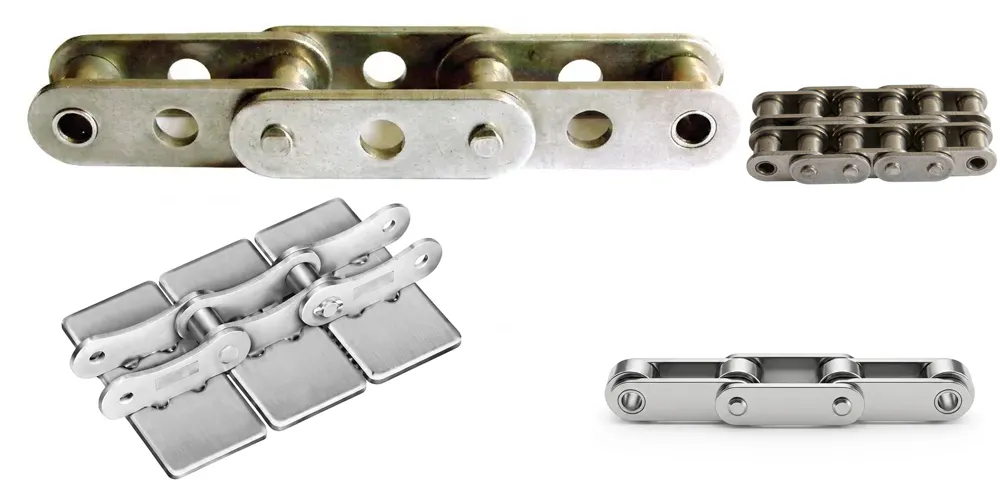
Three strands of ANSI #100 roller chain — each with 1-1/4" pitch, 0.750" roller diameter, and inner link dimensions to ANSI B29.1 — are required per installation of this American sprocket. Sourcing all three strands from the same supply batch minimises chain length variation between strands, which is the principal factor in achieving equal tension distribution across all three tooth face sets on the American sprocket hub. Our industrial supply network covers ANSI/ASME, DIN/ISO, and JIS pitch families for complete system compatibility.
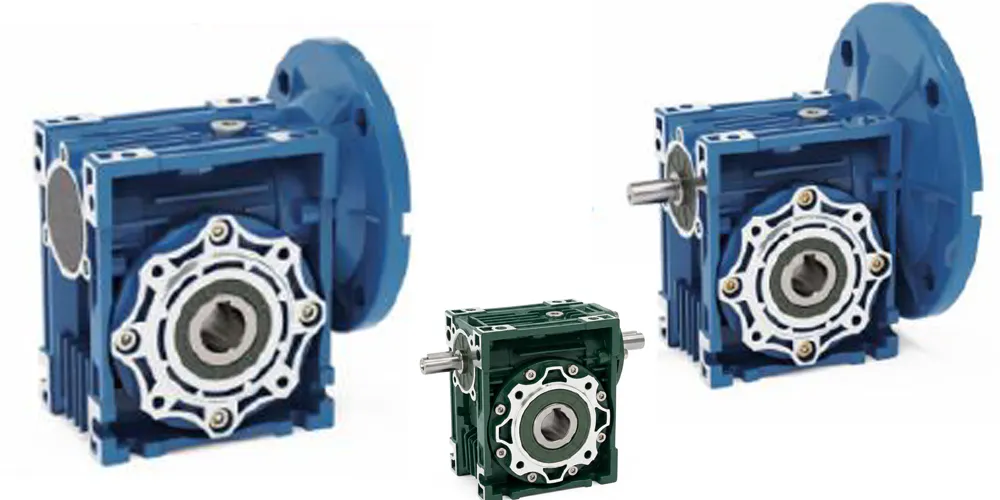
NMRV Worm Gear Reducers
The high torque capacity of the No.100-3 triple-strand American sprocket configuration is most effectively utilised when the input shaft speed is correctly reduced before the chain stage. NMRV worm gear reducers — right-angle, compact, ratios from 5:1 to 100:1 — provide the speed reduction input stage that matches motor output speed to the required chain speed at the American sprocket. Standard NMRV output shaft bore dimensions are compatible with the lower-end bore range of Type B units in this series, making the reducer-to-sprocket connection straightforward for most standard applications. For heavy Type C installations, custom output shaft adapters are available.
8. ہمارے بارے میں
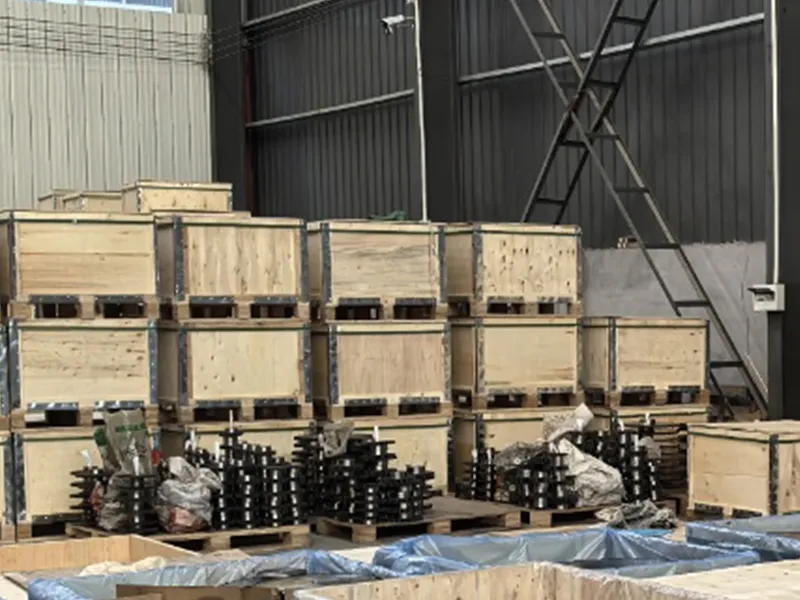
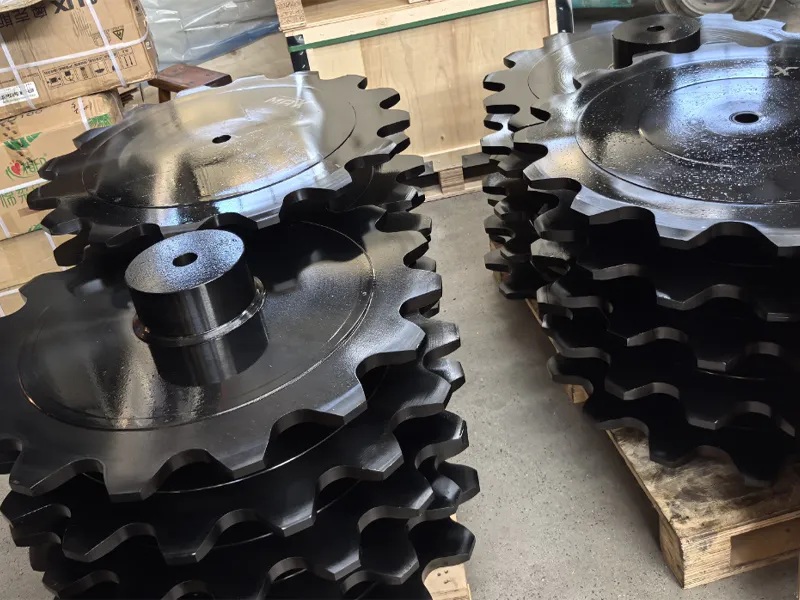
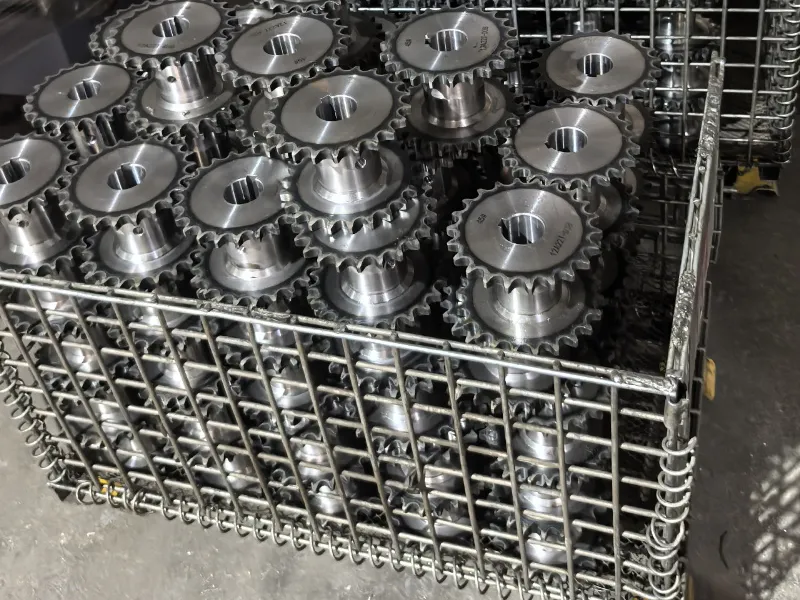
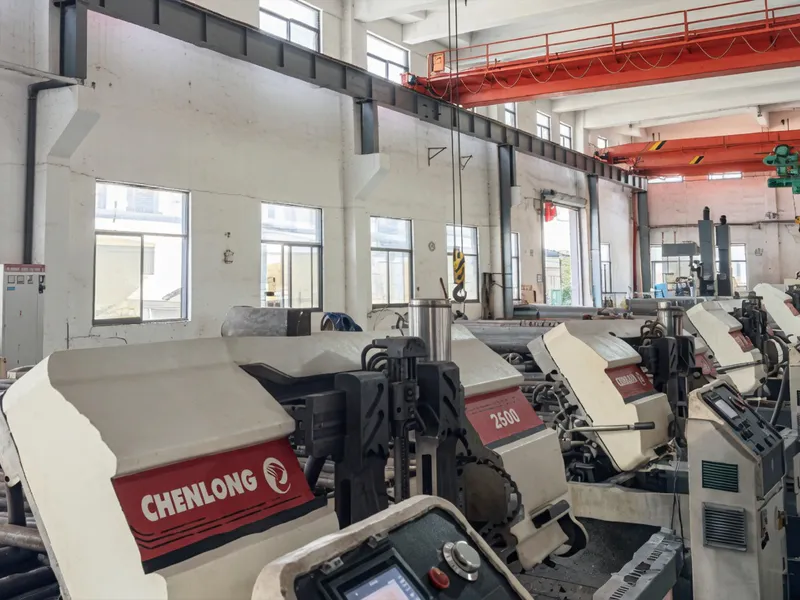
Manufacturing precision power transmission components since 2010, we have developed expertise in both single-strand and multi-strand American sprocket production across the ANSI pitch range. Our CNC machining centres are configured for the simultaneous multi-face tooth-width tolerancing that triple-strand American sprocket production demands — holding b1, B2, and B3 to ANSI B29.1 acceptance criteria on the same cutting pass, not as sequential operations. Every triplex sprocket tooth is cut, dimensionally checked, and documented within our own manufacturing environment, providing buyers with traceable conformity records from steel bar stock through to final inspection.
Our product range spans American ANSI/ASME, European DIN/ISO, and Asian JIS roller chain sprocket standards, plus a full range of industrial sprockets and gears covering spur, bevel, and rack formats to DIN 782. Buyers sourcing roller chain sprockets across multiple global standards can work with one qualified American sprocket manufacturer rather than managing separate supplier relationships for each standard family. Each ANSI sprocket tooth profile is verified against ANSI B29.1; European sprocket profiles against DIN 8187; JIS profiles against JIS B 1801. Gear tooth accuracy is documented to DIN 3961 / ISO 1328 levels. Stock American sprocket units in common configurations ship within the week; OEM custom variants are supported by our engineering team with full dimensional documentation packages.
ورکشاپ
اکثر پوچھے گئے سوالات
ایڈیٹر: PXY